

TSA Vitamins Rules: What You Can Pack in 2026
Yes, TSA allows vitamins and dietary supplements through security, and the rules split by form. Pills, capsules, gummies, and oral strips count as solids with no quantity limit. Liquid vitamins and supplement gels fall under the 3-1-1 rule, capped at 3.4 ounces (100 ml) per container in carry-on. Powders are allowed too, but anything over 12 ounces (350 ml) in your carry-on gets pulled for separate screening.
Here’s the quick version before you pack:
- Solids win on convenience. Pills, gummies, and oral strips travel in unlimited quantities in both carry-on and checked bags.
- Liquids need the quart bag. Anything over 3.4 oz (100 ml) either goes in checked luggage or gets declared as medically necessary.
- Big powder containers slow you down. Cross 12 oz (350 ml) in a carry-on and expect a separate bin and possibly a longer look.
Key Takeaways
TSA permits vitamins and supplements in every common form, but liquids and large powders trigger extra screening steps that solids never face.
| Point | Details |
|---|---|
| Solids travel freely | Pills, gummies, and oral strips carry no quantity limit in carry-on or checked bags. |
| Liquids follow 3-1-1 | Cap liquid vitamins at 3.4 oz (100 ml) and pack them in your quart bag. |
| Powders over 12 oz need separate screening | Containers above 350 ml in carry-on get pulled for their own X-ray pass. |
| Declare medical exceptions early | Medically necessary liquids can exceed 3.4 oz once declared to the officer. |
| Original labels speed things up | Clear labeling isn’t required but cuts down on follow-up questions at the belt. |
Table of Contents
- TSA Vitamins Rules by Supplement Form
- How to Pack Vitamins So Screening Goes Faster
- The 12-Ounce Powder Rule Explained
- What Happens at the Checkpoint
- Why Oral Strips Sidestep the Whole Problem
- Ready to Pack Smarter for Your Next Flight?
- What Most Packing Advice Gets Wrong
- Sources
TSA Vitamins Rules by Supplement Form
Every supplement format gets treated differently at the checkpoint, and knowing which bucket yours falls into saves you a conversation with a TSA officer you’d rather skip.
Pills, capsules, and gummies are classified as solids. TSA’s own guidance on vitamins confirms these are permitted in both carry-on and checked baggage with no cap on quantity. The supplements page backs this up, listing vitamins and supplements as a “yes” for both bag types. That said, the final call always belongs to the officer standing at the X-ray machine.
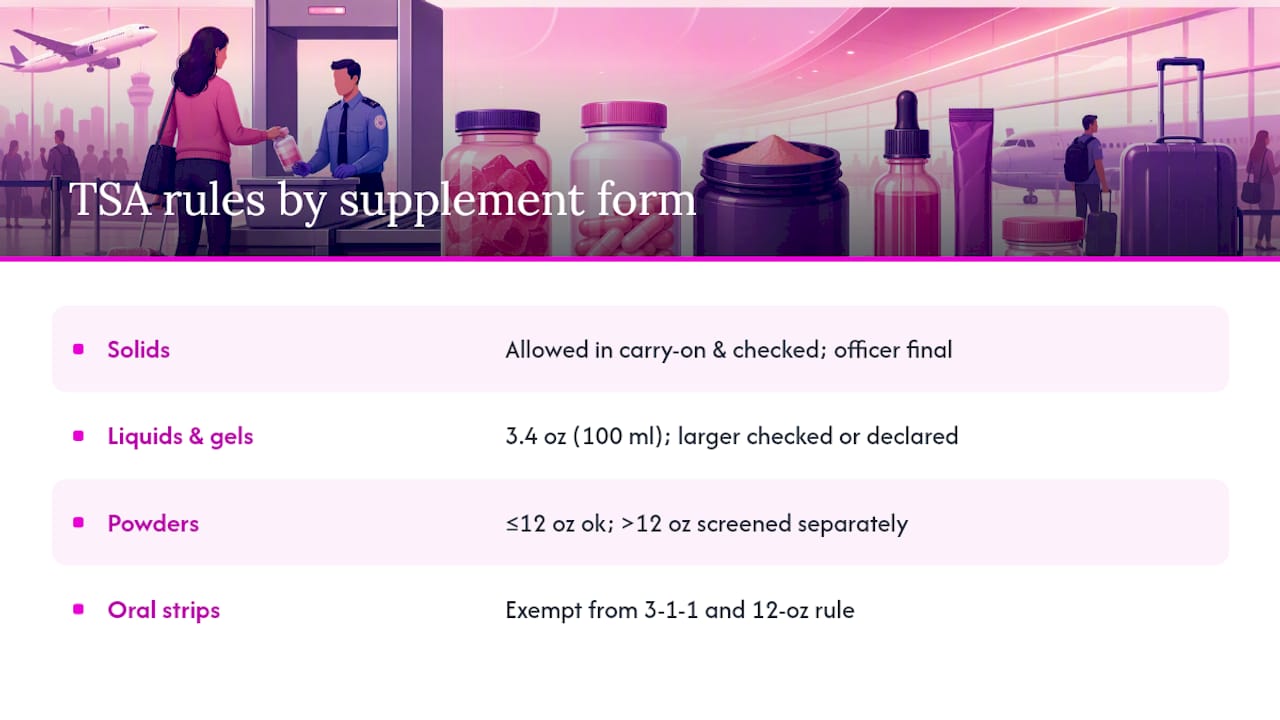
Liquid vitamins and supplement gels follow the standard 3-1-1 liquids rule. Carry-on containers max out at 3.4 ounces (100 ml), and they need to fit inside a single clear quart-sized bag. Bring larger bottles of liquid vitamin D or fish oil concentrate, and they either go in checked luggage or must be declared as medically necessary.
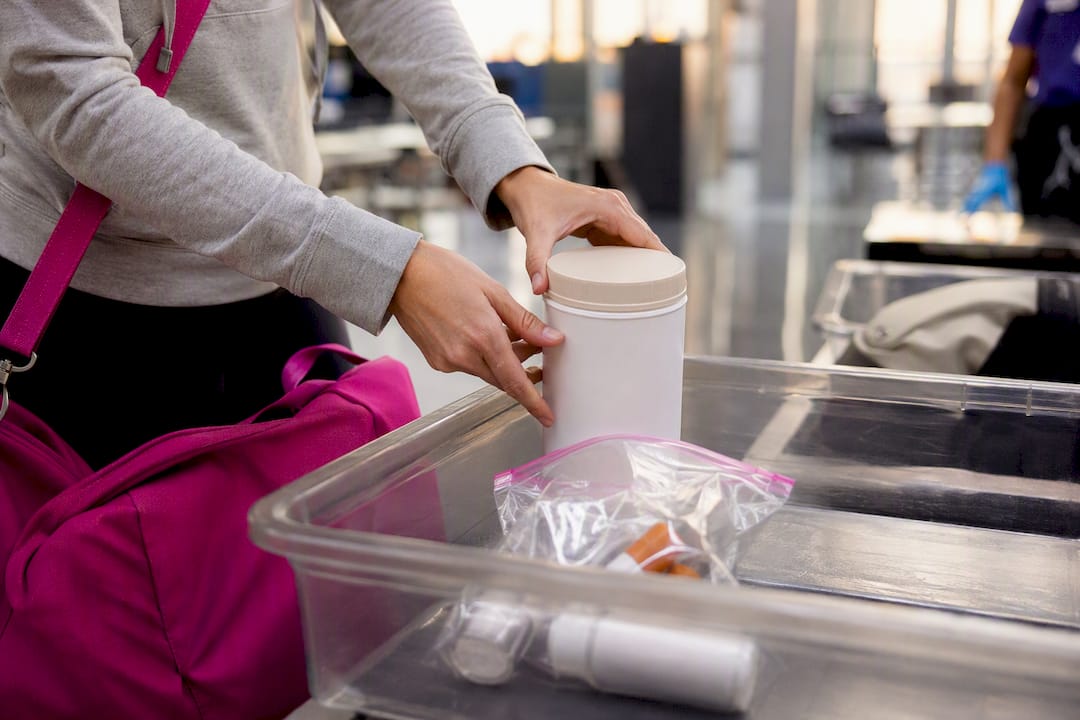
Powder supplements get their own threshold. Protein powders, greens blends, and electrolyte mixes are fine to bring, but containers over 12 ounces (350 ml) in a carry-on must be pulled and screened in a separate bin.
Pro Tip: Oral strips dissolve on the tongue and never register as a liquid or a loose powder on an X-ray screen, which is exactly why they sidestep both the 3-1-1 rule and the 12-ounce powder threshold entirely.
How to Pack Vitamins So Screening Goes Faster
A little prep at home turns a five-minute checkpoint delay into a non-event, with practical tips for protecting and organizing your gear in checked bags from Travel with Golf Clubs: Pack, Protect, and Avoid Fees - Golf Blab.
- Keep original containers when you can. Officers move faster when a bottle’s label matches what’s inside; if you use a pill organizer, snap a photo of the original label or keep an ingredient list handy, since TSA’s travel tips note that clear labeling speeds screening even though it’s not required.
- Bag your liquids properly. Anything under 3.4 oz goes into your one clear quart bag alongside other toiletries.
- Separate large powders before you get to the belt. If your protein tub tops 12 oz, pull it out proactively instead of waiting for the officer to ask.
- Carry medically necessary items with you, not in checked bags. Pack backup supplies or bulk quantities in checked luggage, but keep anything you actually need mid-flight in your carry-on where you can declare it.
For travelers who mix supplement routines with electrolyte or hydration packets, this guide to gluten-free electrolyte packets walks through similar powder-packing logistics.
The 12-Ounce Powder Rule Explained
The 12 oz (350 ml) threshold exists because powders, unlike pills, can mask other substances on an X-ray, so TSA treats large quantities with more scrutiny.
- Under 12 oz: screens normally with the rest of your carry-on.
- Over 12 oz: must be removed and placed in a separate bin for its own X-ray pass, and TSA may run additional testing on it.
- If it can’t be cleared: the officer can require you to check the bag or, in rare cases, leave the item behind.
Frequent flyers and athletes who travel with bulk protein or creatine avoid this altogether by pre-measuring into travel-sized packets under 12 oz or shifting the bulk container to checked luggage, where the size limit doesn’t apply.
What Happens at the Checkpoint
TSA officers have final authority over anything that alarms or looks unclear on screen, regardless of what the general rule says. That means a bottle of gummy vitamins that looks fine on paper can still get a second look if it’s packed oddly or mixed in with other loose items.
If you’re carrying a medically necessary liquid supplement over 3.4 oz, declare it before it hits the X-ray belt. Officers will run additional screening, but TSA’s own guidance on traveling with medication confirms these items are exempt from the standard limit once declared.
- You can request a visual inspection instead of X-ray for medications, a detail most travelers never think to ask for.
- TSA Cares offers extra support for travelers who need help navigating screening with medical items or devices.
- Roughly 3.4 ounces is your hard cutoff for undeclared liquids, so anything close to that line is worth double-checking before you leave the house.
Why Oral Strips Sidestep the Whole Problem
Oral strips dissolve directly on the tongue, which means they’re classified as solids, not liquids or powders. That single fact removes them from both the 3-1-1 conversation and the 12-ounce powder threshold entirely.
- No quart bag required. Strips pack flat in a wallet, pouch, or carry-on pocket.
- No separate bin. They screen the same way a strip of gum would.
- No guessing at ounces. There’s nothing to measure because there’s no liquid or loose powder involved.
Nukalove builds its travel supplement line around exactly this format. Products like the GLOW GETTER oral strips pack flat, need no refrigeration, and clear security the way a solid always does. For travelers juggling jet lag on top of packing logistics, this guide to jet lag supplements for menopausal women covers formats built the same way.
| Point | Details |
|---|---|
| Oral strips avoid two rules at once | They skip both the 3.4 oz liquids cap and the 12 oz powder screening threshold. |
| No measuring required | Solid format means no counting ounces or checking bag limits before a flight. |
| Fits any carry-on pocket | Flat packaging takes up less space than bottles or powder tubs. |
Ready to Pack Smarter for Your Next Flight?
Packing vitamins for a flight shouldn’t require a packing spreadsheet. If you’re tired of measuring liquid bottles or separating powder tubs at the checkpoint, Nukalove’s oral strip line handles energy, sleep, and skin support without triggering either the 3-1-1 rule or the powder threshold. Browse the wellness collection for travel-ready bundles, or start with the GLOW GETTER strips built for exactly this kind of trip. Nukalove ships nationwide across the United States, so restocking between flights is never a problem.
What Most Packing Advice Gets Wrong
Most articles on this topic treat vitamins as one category, when TSA actually treats them as three: solids, liquids, and powders, each with its own logic. The conventional advice, “just bring your vitamins, you’ll be fine,” ignores the fact that a protein shake mix or a liquid B-complex can genuinely slow you down at a crowded checkpoint.
The bigger miss is that travelers rarely think about format until they’re already standing in the security line juggling a powder tub they should have checked. Prioritizing solid, single-serving formats before you even start packing solves the problem before it starts. That’s not a workaround. It’s the format TSA’s own rules were practically designed to reward, and it’s worth building your travel supplement kit around from the outset rather than troubleshooting it at the checkpoint.
— NUKA