

Reset in 24–48 Hours: Travel Fatigue Recovery for Midlife Women
Rehydrate, get outside into local daylight, take a short walk, and protect your first night’s sleep. That sequence, done in order, does more for travel fatigue recovery than any single remedy. Ordinary travel fatigue clears in 24 to 48 hours, while true jet lag takes roughly one day per time zone crossed. Skip heavy alcohol, and cap naps at 30 minutes.
TL;DR:
- Hydrating steadily with water and electrolytes immediately after landing supports faster recovery and reduces dehydration-related fatigue.
- Moving within the first hour and exposing yourself to daylight helps reset your circadian clock more quickly.
- Drinking alcohol and caffeine during travel delays sleep quality and prolongs jet lag, especially if consumed in flight.
- Adjusting your sleep schedule gradually days before departure and arriving late in the day accelerates circadian realignment.
- Booking a buffer day after long trips allows your body to recover fully by prioritizing rest, light exposure, and minimal stress.
Table of Contents
- Quick-Action Checklist for the First 6 Hours After Landing
- What Pre-Flight and In-Flight Habits Actually Shorten Recovery?
- What Should Your First 48 Hours on the Ground Look Like?
- Eastward vs. Westward Travel: Why Direction Changes the Playbook
- Tactics That Speed Up Physical and Mental Recovery
- Nutrition and Supplement Guidance for Faster Recovery
- How Long Does Travel Fatigue Recovery Actually Take?
- When Should You Seek Medical Care After Travel?
- How NUKA Approaches Travel Recovery for Midlife Women
- Why I Always Book a Buffer Day After Long Trips
- A Travel Kit That Works With Your Recovery Plan, Not Against It
- Sources
Quick-Action Checklist for the First 6 Hours After Landing
The first six hours set the tone for everything else. Your body still thinks it’s somewhere else, and every choice you make now either nudges it toward the new time zone or keeps it stuck.
- Rehydrate immediately. Drink water steadily rather than one big bottle, and add an electrolyte packet if you were in the air more than four hours.
- Move within the first hour. A 10 to 15 minute walk restarts circulation and lowers deep vein thrombosis risk after long sitting.
- Get outside if it’s daytime locally. Sunlight is the strongest signal your circadian clock responds to.
- Nap only if you must, and cap it at 20 to 30 minutes. Anything longer pushes you into deep sleep and makes the grogginess worse, not better.
- Set your room up before you’re tired. Blackout curtains, a fan or white noise, and a thermostat around 65°F make a real difference once bedtime actually arrives.
Pro Tip: Pack a compact electrolyte or hydration strip in your carry-on. Fumbling with powder packets in an airport bathroom is harder than it sounds, and a strip dissolves in seconds with no water needed.
What Pre-Flight and In-Flight Habits Actually Shorten Recovery?
Most of your recovery timeline gets decided before you ever land. What you do in the days before departure and the hours in the air either builds a head start or digs a deeper hole.
- Shift your bedtime three to four days out. Move it 15 to 30 minutes per night toward your destination’s schedule. A five-time-zone shift becomes far more manageable when your body has already started drifting that direction.
- Pick flights that land in the late afternoon or evening when possible. Arriving into local daytime gives you hours of usable light before you need to sleep, which speeds circadian realignment.
- Drink roughly 200 to 250 mL of water per flight hour. Cabin air runs far drier than any room you’ve been in, and that dehydration is a major contributor to how wrecked you feel on arrival.
- Limit alcohol and caffeine in flight. Both disrupt the fragmented sleep you might otherwise grab, and alcohol worsens dehydration at altitude.
- Get up and move every couple of hours. Ankle circles, calf raises, and short aisle walks limit the circulatory stasis that leads to swelling and stiffness.
- Only attempt sleep on the plane if it aligns with your destination’s nighttime. Sleeping at the wrong time reinforces the wrong clock and can make jet lag last longer.
Peer-reviewed consensus guidance for managing travel fatigue and jet lag backs this combination of light exposure, sleep timing, and hydration as the most reliable lever available to travelers, not just elite athletes.
What Should Your First 48 Hours on the Ground Look Like?
Your arrival day matters more than any other day of the trip. Here’s the practical breakdown.
Hour zero to two: Hydrate steadily, take a 15 to 20 minute walk outside, and get direct light exposure. Eat your next meal on local time, even if your stomach disagrees.
Deciding whether to nap: If you land in the morning, a short nap (20 to 30 minutes, no more) before early afternoon is fine. If you land in the evening, skip the nap entirely and push through to a normal local bedtime instead.
- Morning arrival, feeling wrecked: 20 to 30 minute nap before 3 p.m., alarm set.
- Evening arrival: no nap. Light dinner, dim the lights early, go to bed at your normal local time.
Night one: This is where sleep gets protected or lost. Keep the bedroom cool, dark, and quiet, which experts associate with better sleep quality. Skip heavy, late meals, and consider low-dose melatonin timed to your new bedtime rather than your old one.
Day two: Get up at your intended local wake time no matter how you slept. Get morning light again, save any hard exercise for late morning or early afternoon, cut caffeine by early afternoon, and keep meals on the new local schedule.
Pro Tip: If night one goes badly, don’t panic and abandon the schedule. One rough night doesn’t reset the clock; staying consistent with wake time on day two matters more than how well you slept.
Eastward vs. Westward Travel: Why Direction Changes the Playbook
Flying east means your body needs to move its clock forward; flying west means it needs to fall back. Those are opposite biological tasks, and they call for opposite tactics.
Morning light advances your circadian clock, which is what eastward travelers need, while evening light delays the clock, which is what westward travelers need. Get the direction backward and you can actually extend your jet lag instead of shortening it.
- Eastward (for example, US to Europe): Seek bright light in the morning at your destination, avoid bright light in the evening, and consider 0.5 to 1 mg of melatonin about 90 minutes before your new target bedtime.
- Westward (for example, Europe to US): Seek light in the late afternoon and evening, keep mornings dim if you wake too early, and delay melatonin use until closer to your actual new bedtime.
- Exercise timing: A brisk walk or workout in the morning helps eastward travelers advance their clock faster; the same workout scheduled for early evening helps westward travelers delay theirs.
Combining timed light with correctly timed melatonin can compress the adjustment period by roughly an hour per day when meals and exercise stay aligned to the new schedule too. Eastward trips generally hurt more, since advancing the clock fights against your body’s natural tendency to drift later, not earlier.
Tactics That Speed Up Physical and Mental Recovery
Recovery isn’t just about sleep. Your hydration status, light exposure, and movement patterns all interact, and getting even one of them wrong slows the other two down.
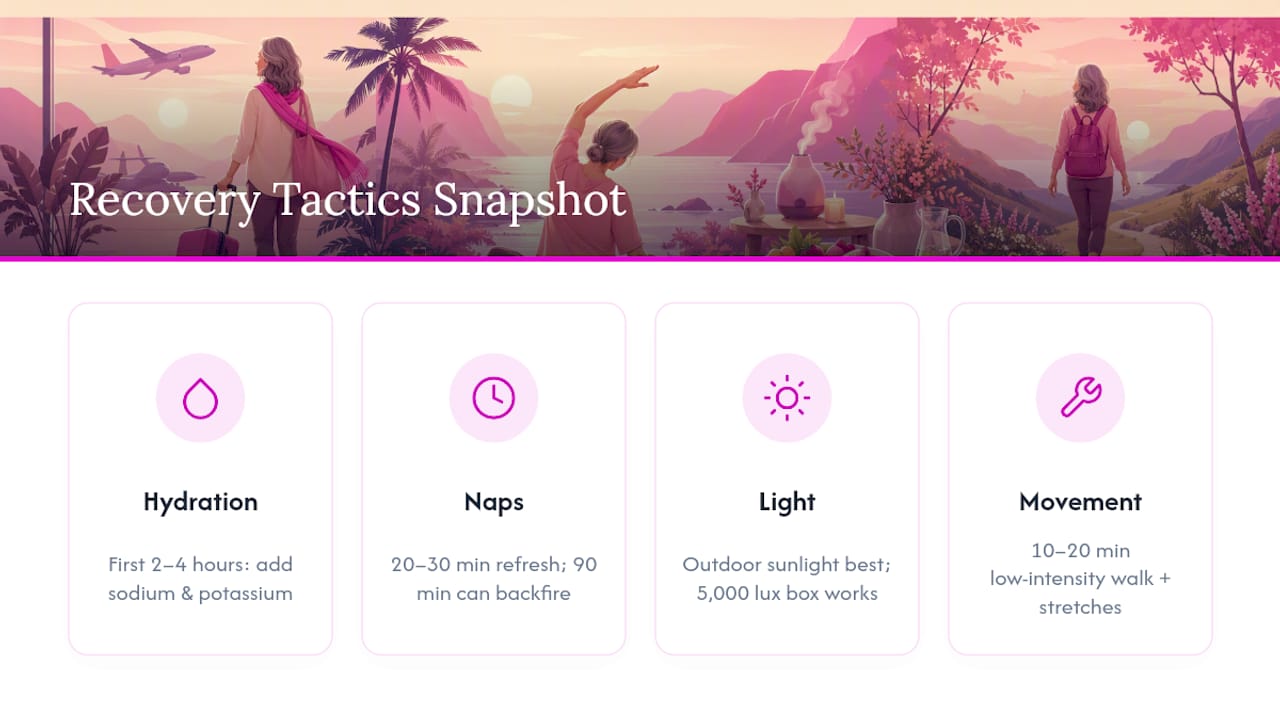
Hydration and electrolytes. The first two to four hours after landing matter most. Water alone isn’t always enough if you were dehydrated from the flight; adding sodium and potassium through an electrolyte mix or a timed electrolyte strip helps your body actually retain the fluid instead of flushing it straight through.
Nap science. A 20 to 30 minute nap keeps you in lighter sleep stages, so you wake up refreshed rather than foggy. A 90 minute nap completes a full sleep cycle, which sounds better on paper but often backfires: you either wake up disoriented from deep sleep or oversleep into a state that makes nighttime sleep harder to fall into.
Light exposure options. Natural outdoor sunlight remains the gold standard, but on cloudy days or during winter travel, a 5,000 lux light therapy box or even a portable light visor can substitute reasonably well.
Movement routines. A 10 to 20 minute low-intensity walk, paired with calf and hip stretches, reduces the stiffness that builds up from hours in a cramped seat. Some travelers add a hydromassage session once they’re home, since the combination of gentle heat and pressure helps loosen muscles that stayed tense during a long flight.
Sleep environment. Keep the room around 65°F, block outside light completely, and use a fan or white noise machine if the space is unfamiliar. Clinical guidance from Cleveland Clinic also recommends avoiding unfamiliar heavy foods right after arrival, since digestive stress compounds sleep disruption on top of the circadian mismatch you’re already managing.
A five-time-zone trip can realistically take four to six days to fully normalize, even when you do everything right. That’s simply the math of one day of adjustment per zone crossed.
Nutrition and Supplement Guidance for Faster Recovery
Switching your meal times to match local time the moment you land helps your body treat the new schedule as real, not temporary. Eating breakfast at 7 a.m. local time tells your internal clock something that no amount of willpower alone can.
- Melatonin: Low doses of melatonin, taken about 90 minutes before your target bedtime, can help adjust the circadian clock; higher doses do not increase effectiveness and may cause mistimed effects. Melatonin works as a circadian signal rather than a sedative.
- Magnesium glycinate: A 100 to 200 mg dose at bedtime is commonly used to ease travel-related leg twitching and support sleep onset; the glycinate form absorbs better than magnesium oxide.
- Electrolyte timing: Sip a sachet or strip within the first two hours of landing, then again before bed, rather than dumping it all in one sitting.
- New supplements: Never test something unfamiliar for the first time on travel day. Try it at home first, and check with your provider if you take other medications.
Pro Tip: Keep your sleep and hydration aids in strip form when you travel. No water, no measuring, no spilled powder in a shared hotel bathroom at 6 a.m.
How Long Does Travel Fatigue Recovery Actually Take?
Plain travel fatigue, the general exhaustion from sitting in transit and disrupted routines, tends to resolve within 24 to 48 hours. Jet lag, the deeper circadian mismatch from crossing time zones, follows a rougher rule: about one day of adjustment per zone crossed.
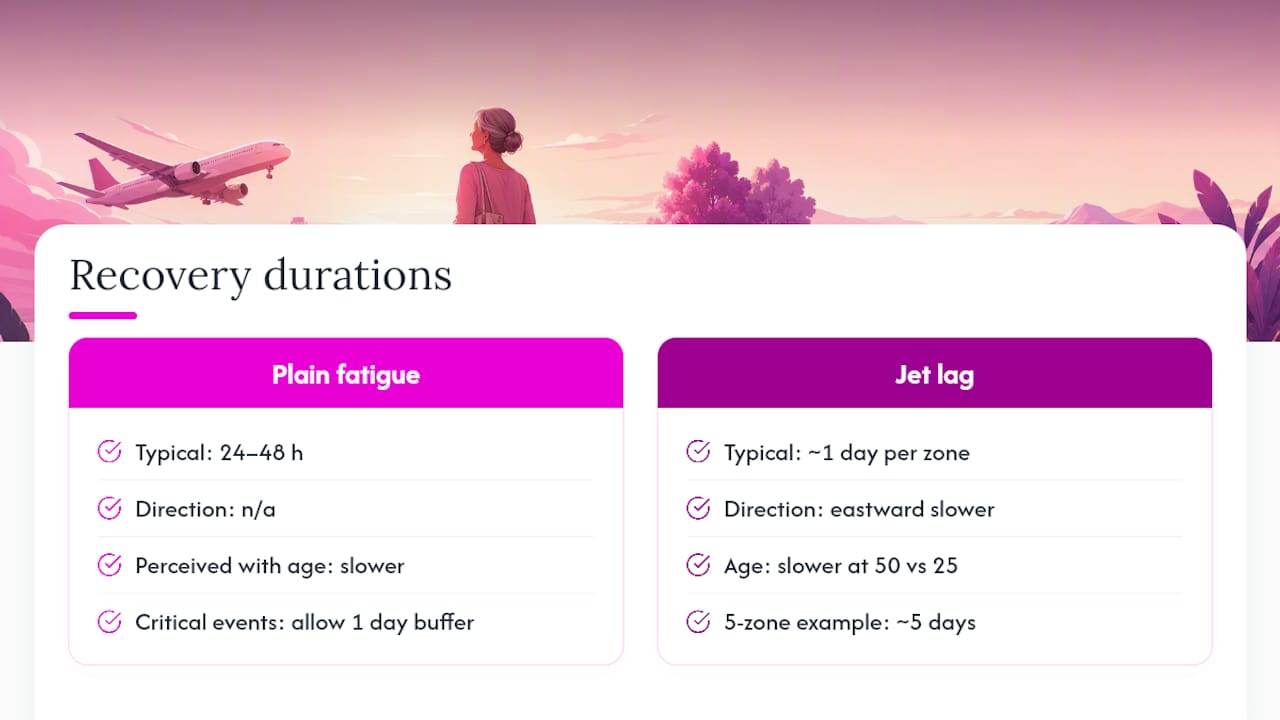
Eastward travel usually takes longer to shake than westward, because advancing your clock fights your body’s natural rhythm. Age plays a role too. Circadian flexibility declines somewhat over the decades, which is one reason recovery can feel slower at 50 than it did at 25.
Judge your progress by whether you’re waking without an alarm near your intended time and staying alert through the afternoon without a crash. If you have anything critical scheduled, a major presentation, a race, an important negotiation, try to build in a buffer day before it, especially after crossing five or more time zones.
When Should You Seek Medical Care After Travel?
Most travel fatigue resolves on its own, but a few symptoms need attention right away. Unilateral leg swelling, chest pain, or sudden breathlessness can signal a blood clot and warrant emergency care, not a wait-and-see approach.
Persistent severe insomnia or worsening neurological symptoms lasting beyond a week are worth a call to your primary care provider. General fatigue or mild confusion can usually wait for a regular appointment; anything involving chest, breathing, or one-sided swelling should go to urgent or emergency care immediately. Travelers with clotting risk factors should ask a provider about compression stockings before long flights.
How NUKA Approaches Travel Recovery for Midlife Women
Travel fatigue hits differently when you’re also managing hot flashes, brain fog, or fragmented sleep tied to menopause. A cabin that runs warm can trigger a flash mid-flight; a missed meal window can worsen the fog you’re already fighting. NUKA built its travel-specific menopause guidance around exactly that overlap, because generic jet lag advice rarely accounts for it.
Compact oral strips solve a real packing problem by being small and easy to carry without adding bulk or mess. That matters most in the exact moments recovery tactics call for, like taking an electrolyte dose right after landing or addressing afternoon brain fog without hunting for a water bottle in an unfamiliar city.
Why I Always Book a Buffer Day After Long Trips
Travel is a real physical stressor, not just an inconvenience, and treating it that way changes how you plan. Booking a genuinely low-demand day after a long trip, no meetings, no big decisions, just movement, light, and sleep, does more for recovery than any single remedy on this list.
The travelers who bounce back fastest aren’t the ones with the best supplements. They’re the ones who protected one boring day to let the protocol actually work. Build that buffer in before you book the flight, not after you land exhausted.
— NUKA
A Travel Kit That Works With Your Recovery Plan, Not Against It
Behavioral steps like light timing, hydration, and walk breaks do most of the heavy lifting for travel fatigue recovery. Oral strips can slot into that plan without adding another thing to pack or measure. Deep ZZZs oral sleep strips dissolve fast when you’re trying to protect your first night in a new time zone, no water, no waiting.

For daytime fog and the mental static that follows a long flight, the Clarity focus strips are formulated with lion’s mane and cordyceps and fit in a jacket pocket for exactly the moment you need them at a gate or in a rental car. Pack strips in your carry-on rather than checked luggage, since you’ll want them within the first hours of landing, not after baggage claim. Browse the full wellness collection to build a travel kit that matches your specific recovery needs, whether that’s sleep, hydration, or focus.
This article is general information, not a substitute for advice from a qualified doctor. Consult a qualified healthcare professional about your own circumstances before acting on anything here.
Sources
- Managing travel fatigue and jet lag in athletes: a review and consensus statement
- Cleveland Clinic: Jet Lag
- Sleep Foundation: Best temperature for sleep