

Swollen Feet After a Flight: Causes, Relief, and Red Flags
Mild swelling of both feet and ankles after a flight is common and almost always temporary. According to Mayo Clinic, leg and foot swelling during air travel is usually harmless, and for healthy people on shorter flights, the risk of deep vein thrombosis (DVT) is very low. The moment you land, remove tight shoes, walk the terminal, drink water, and elevate your feet when you sit down. Those four steps handle most cases.
Act now if you notice any of these:
- Both feet mildly puffy and equally swollen: normal, monitor and use the remedies below
- One foot or leg significantly more swollen than the other: seek urgent care within 24 hours
- Calf pain, warmth, or redness: possible DVT, see a clinician today
- Sudden shortness of breath or chest pain: call 911 immediately
Key Takeaways
Mild, bilateral swelling after a long flight is normal and usually resolves within a day or two; one-sided swelling with pain or breathing difficulty requires urgent medical evaluation.
| Point | Details |
|---|---|
| Swelling is usually temporary | Both feet mildly puffy after a long flight is common; most cases resolve within 24 hours. |
| Move and hydrate in-flight | Calf raises every 15–20 minutes and consistent water intake replace the calf-muscle pump. |
| Wear graduated compression socks | Put them on before boarding; 15–20 mmHg travel-grade socks are the most evidence-backed prevention tool. |
| Elevate after landing | Feet above heart level for 15–20 minutes speeds fluid drainage and relieves discomfort. |
| Know the red flags | One-sided swelling, calf pain, or sudden shortness of breath after travel needs same-day clinical evaluation. |
Table of Contents
- Why do feet swell on flights? The physiology explained
- How to tell normal travel swelling from a serious problem
- How to prevent foot swelling on planes before and during your flight
- How to reduce swollen feet after you land
- How long does swelling last after a flight?
- When should you see a doctor after a flight?
- What the research says about compression and calf-pump function
- Our perspective on travel wellness and this guide
- Sources
Why do feet swell on flights? The physiology explained
The main driver is venous pooling. When you sit still for hours, your calf muscles stop contracting, and those muscles are the primary pump that pushes blood back up from your lower legs toward your heart. Without that pump running, blood and fluid accumulate in the veins and soft tissue of your feet and ankles.
Cabin conditions make it worse. Aircraft cabins are typically pressurized to the equivalent of 6,000–8,000 feet of altitude, and the air is extremely dry. These conditions promote fluid shifts and compound the pooling that prolonged sitting already causes. Dehydration, salty airport food, and alcohol all tip the fluid balance further in the wrong direction.
Several factors raise your personal risk:
- Flight duration: Risk stays low on short hops; it begins climbing on flights over 12 hours
- Pregnancy: Increased blood volume and hormonal changes make swelling more likely
- Obesity: Added pressure on pelvic veins restricts return flow
- Varicose veins or prior DVT: Already-compromised venous valves pool fluid faster
- Certain medications: Calcium channel blockers, corticosteroids, and some hormonal therapies can promote fluid retention
- Recent surgery or active cancer: Both significantly raise clot risk during travel, per CDC travel guidance on DVT
Economy class seats compound all of this. Less legroom means less spontaneous movement and more pressure behind the knees.
How to tell normal travel swelling from a serious problem
Benign travel-related edema has a recognizable pattern: both feet or ankles are mildly puffy, the skin is not discolored or hot, and the swelling improves within hours of walking and elevating your legs. It is uncomfortable but not painful in a sharp or localized way.
Signs that suggest something more serious:
- Swelling in only one leg or foot
- Persistent or worsening calf pain, tenderness when you press the muscle
- Skin that is warm, red, or visibly streaked
- Fever alongside swelling
- Sudden shortness of breath, chest pain, or feeling faint
These are the recognized warning signs of blood clots, including DVT and pulmonary embolism (PE). The CDC is direct: seek medical care if you experience swelling, pain, warmth, or sudden breathing difficulty.
The two-week window is the key triage point. Clots can form during travel and declare themselves days later, not just immediately after landing.
How to prevent foot swelling on planes before and during your flight
Prevention works best when you start before you board.
Before you fly:
- Hydrate well the day before and morning of travel
- Avoid high-sodium meals at the airport
- Wear loose, comfortable shoes you can slip off easily
- Put on graduated compression socks before boarding, not mid-flight
During the flight:
- Stand and walk the aisle for a few minutes every hour when the seatbelt sign is off
- Do in-seat calf raises and ankle circles every 15–20 minutes; occupational therapists describe this as replacing the calf-muscle pump that sitting shuts down
- Avoid crossing your legs, which restricts popliteal blood flow
- Limit alcohol and caffeine, both of which dehydrate you
- Drink water consistently throughout the flight
Seat selection: An aisle seat lets you stand without climbing over anyone. Bulkhead and exit-row seats offer more legroom. If you have a known risk factor for DVT, CDC recommends discussing preventive measures with a clinician before long-haul travel.
Compression garments: Graduated compression stockings (GCS) are the most evidence-backed wearable intervention for preventing foot swelling on planes. Travel-grade socks typically run 15–20 mmHg at the ankle. The key word is graduated: pressure is highest at the ankle and decreases up the leg, which actively assists venous return. Knee-high socks cover the area most prone to pooling and are easier to manage than full-length tights.
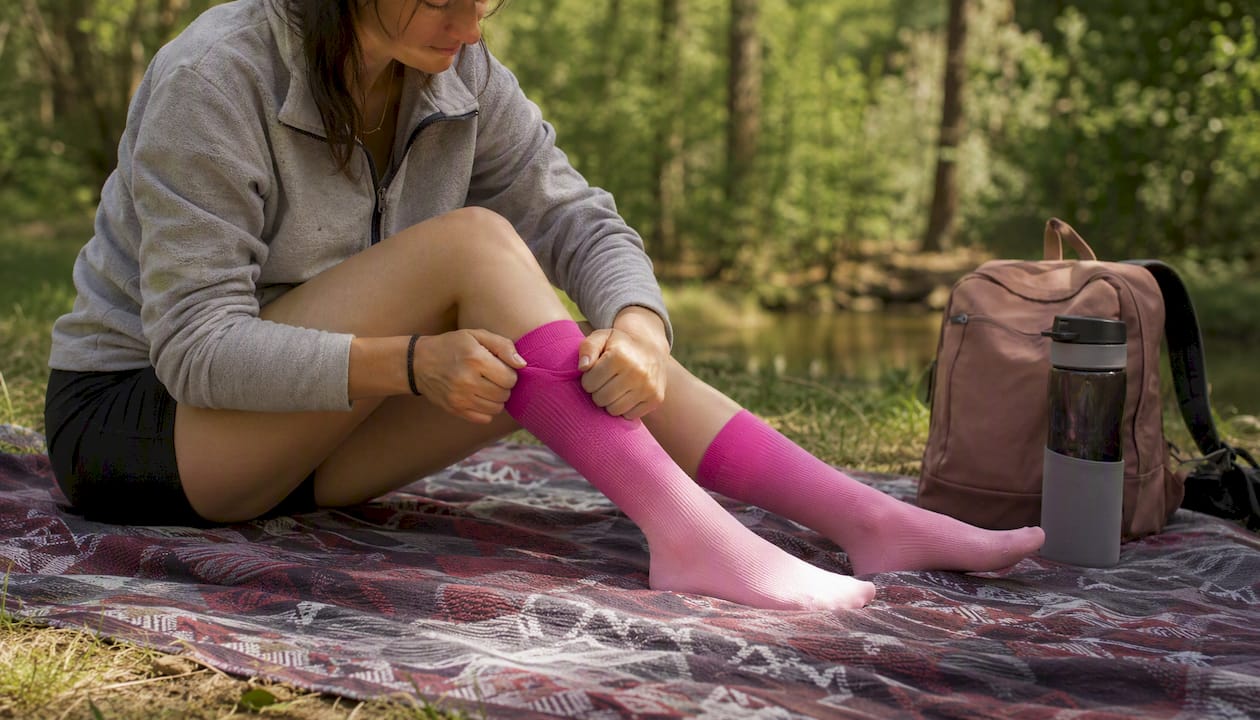
Pro Tip: Pack your compression socks in your personal item, not your checked bag. Put them on in the departure lounge before boarding. Trying to pull them onto already-puffy feet mid-flight is both harder and less effective.
How to reduce swollen feet after you land
The goal post-flight is to restart circulation and drain the pooled fluid.
Immediate steps at the airport:
- Remove tight shoes or loosen laces as soon as you deplane
- Walk briskly through the terminal rather than taking the moving walkway
- Do 20 calf raises while waiting at baggage claim
- Drink a full glass of water before you leave the airport
Once you are seated or at your accommodation:
- Elevate your feet above heart level for 15–20 minutes. Lying on a bed with your legs propped on two pillows works well.
- Apply a cold pack wrapped in a cloth to each ankle for 10–15 minutes to reduce inflammation
- Self-massage: use firm strokes directed upward from the foot toward the knee, following the direction of venous flow back toward the heart
- Keep compression socks on for another hour or two if swelling is still noticeable
At home over the next 24 hours:
- Short walks every hour keep the calf pump active
- Avoid standing still for long periods
- Continue hydrating and reduce sodium intake
How long does swelling last after a flight?
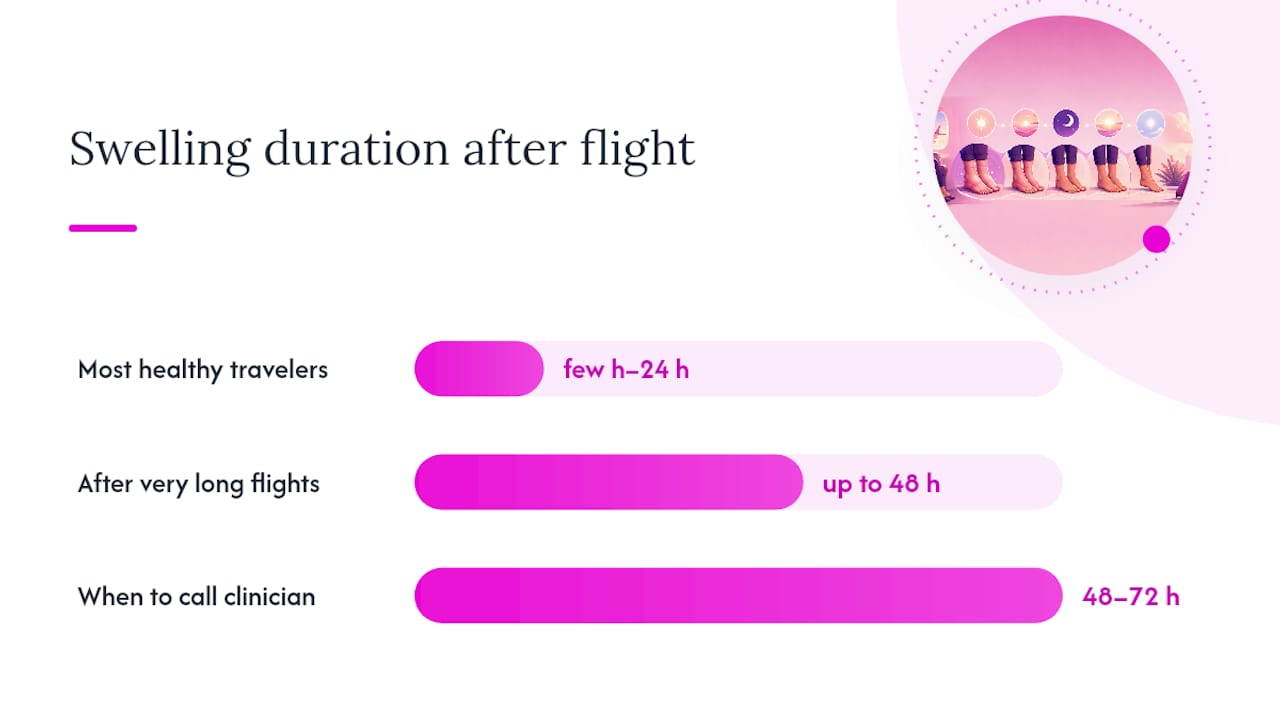
For most healthy travelers, swelling resolves within a few hours to 24 hours after landing. Some people, particularly after very long flights, notice mild puffiness for up to 48 hours.
Several factors push recovery time longer:
- Underlying conditions: Heart failure, kidney disease, or liver disease impair fluid regulation and can turn travel-related swelling into a more persistent problem
- Obesity or pregnancy: Both slow venous return and extend recovery
- Medications: Certain drugs that cause fluid retention will prolong swelling regardless of travel
- Flight duration: A 14-hour flight stresses the venous system more than a 3-hour hop; recovery takes proportionally longer
Swelling that has not improved meaningfully after 48–72 hours warrants a call to your clinician, even if it is bilateral and not painful. Recurrent post-flight swelling that keeps coming back is worth evaluating by a specialist. An edema therapist can identify early patterns that suggest progressing lymphatic dysfunction before it becomes a chronic condition.
When should you see a doctor after a flight?
Call 911 or go to the ER immediately for:
- Sudden shortness of breath or chest pain
- Feeling faint or losing consciousness
- Rapid heart rate with no obvious cause after recent travel
See urgent care or your primary care clinician within 24 hours for:
- Swelling in only one leg or foot
- Calf pain, tenderness, or a firm cord-like feeling in the muscle
- Skin that is red, warm, or spreading in discoloration
- Fever alongside leg swelling
What the clinician will check: A physical exam for asymmetric swelling, a D-dimer blood test (elevated in the presence of a clot), and if DVT is suspected, a venous duplex ultrasound. They will also review your travel history, prior clot history, medications, and risk factors like hormone therapy or recent surgery.
What to tell them: “I have swelling in my [left/right] leg that started [X days] after a [X-hour] flight. I [do/do not] have calf pain. I [have/have not] had a prior DVT. I take [medications].” That script gets you to the right test faster.
What the research says about compression and calf-pump function
The evidence for graduated compression garments is solid on subjective outcomes. A randomized crossover trial published in The Medical Journal of Australia found that travelers wearing graduated compression tights reported better post-flight leg comfort, improved perceived energy, and greater alertness compared to those who did not wear them. The benefit goes beyond just reducing puffiness.
The mechanism is the calf-muscle pump. Occupational therapists describe the calf muscles as the lower extremity’s secondary heart: every contraction squeezes blood upward through the venous valves. Sitting removes that pump entirely. Clinical reviews on venous disease consistently identify mobilization and compression as the two interventions with the strongest evidence for managing travel-related edema.
Movement every 15–20 minutes is not optional comfort advice. It is a physiological substitute for the pump your body loses the moment you sit down.
- Compression works best when applied before swelling starts, not after
- Graduated (not uniform) pressure is what drives venous return
- Knee-high length covers the highest-risk zone for pooling
Pro Tip: Compression that is too tight or the wrong length can actually worsen swelling. Get sized properly: your ankle circumference and calf circumference both matter. If you have recurring swelling or a known venous condition, a certified fitter or edema therapist can recommend the right pressure class and length for your specific anatomy.
Our perspective on travel wellness and this guide
At Nukalove, we write for women who are moving through the world, often managing menopause symptoms alongside the demands of travel. Swollen feet after a flight is one of those issues that sits at the intersection of everyday discomfort and genuine medical risk, and we think it deserves a straight answer rather than vague reassurance.
The guidance in this article draws on Mayo Clinic, the CDC, peer-reviewed clinical research, and occupational therapy expertise. For persistent, recurring, or one-sided swelling, please consult a clinician directly. General information is a starting point, not a substitute for a physical exam.
Sources
These are the primary sources behind this article. Each is worth bookmarking if you want clinical detail beyond what a single article can cover.
- Foot swelling during air travel: A concern? - Mayo Clinic
- Randomised crossover study: low ankle-pressure graduated compression tights - The Medical Journal of Australia
- About blood clots | CDC
- PMC article on venous disease and edema (review) - NCBI
- Deep vein thrombosis (DVT) and travel | CDC Travelers’ Health