

Melatonin Peaks in 20–23 min: Sublingual vs Oral Absorption
Sublingual delivery often produces faster onset and can avoid first-pass liver metabolism, but calling it “better” than oral absorption depends entirely on the drug. Nitroglycerin and melatonin sprays show real, measurable gains under the tongue. Vitamin B12 mostly doesn’t; more details on Vitamin B supplements provide useful context for absorption and formulation. The right route depends on the molecule, the formulation, and what you’re actually trying to fix.
TL;DR:
- Sublingual absorption offers faster onset mainly for drugs like nitroglycerin and melatonin, but benefits vary depending on the drug’s first-pass metabolism.
- The effectiveness of sublingual delivery depends on molecule size, lipophilicity, ionization, and patient oral health, with many compounds unable to cross mucosa efficiently.
- Formulation quality, including disintegration speed and contact time, critically influences whether sublingual products truly outperform oral forms.
- Clinical evidence shows sublingual offers substantial advantages only for drugs with high first-pass loss, such as nitroglycerin and certain opioids, but not for high-bioavailability compounds like vitamin B12.
- Proper use, patient-specific factors, and transparent formulation claims determine if sublingual delivery provides reliable absorption in real-world use.
Table of Contents
- What Sublingual vs Oral Absorption Actually Means for Drug Delivery
- Which Molecules and Patients Respond Best to Sublingual Dosing
- How Formulation Choices Determine Whether Sublingual Actually Works
- What Clinical Studies Show: Nitroglycerin, Melatonin, B12, and Buprenorphine
- When Sublingual Delivery Makes Sense and When Oral Is Fine
- Why Absorption Studies Disagree With Each Other
- How Nukalove Designs Around Real Absorption Science
- Why Reliable Absorption Matters More Than Marketing Claims
- Try an Oral Strip Built for Fast, Reliable Absorption
- Sources
What Sublingual vs Oral Absorption Actually Means for Drug Delivery
The difference between sublingual and oral absorption comes down to plumbing. Swallow a pill, and it dissolves in the stomach or small intestine, gets absorbed into blood vessels that feed into the portal vein, and travels straight to the liver before it ever reaches the rest of your body. That trip through the liver is called first-pass metabolism, and for a lot of drugs, it’s where a meaningful chunk of the dose gets broken down before it can do anything useful.
Place something under the tongue instead, and the story changes. The mucosa there sits over a dense network of veins that drain into the superior vena cava, not the portal system. A drug absorbed through that tissue reaches systemic circulation without passing through the liver first. That’s the entire mechanical case for sublingual dosing: skip the liver, keep more of the active compound intact, get it into the bloodstream faster.
Pharmacokinetics researchers measure how well this works using three main markers, and understanding them makes every clinical comparison in this article easier to read.
- Tmax: the time it takes for a drug to hit peak blood concentration. Faster Tmax generally means faster onset of effect.
- Cmax: the peak concentration itself. A higher Cmax can mean a stronger initial effect, but also a higher risk of side effects for some drugs.
- AUC (area under the curve): total drug exposure over time, used to calculate bioavailability, or the fraction of a dose that actually reaches systemic circulation.
Sublingual dosing tends to shorten Tmax and can raise bioavailability, but the size of that effect varies wildly by compound. A comparative pharmacokinetic study found sublingual midazolam produced roughly a fourfold increase in AUC compared with the oral route, while sublingual triazolam showed about a 28% bioavailability increase over its oral counterpart. Same general mechanism, wildly different payoff, because midazolam and triazolam don’t behave identically once they hit mucosal tissue.
Why the gap between drugs is so large: Midazolam undergoes heavy first-pass metabolism when swallowed, so avoiding the liver preserves a lot more active drug. Triazolam already has decent oral bioavailability, so sublingual dosing has less “already-lost dose” to recover. The lesson here isn’t that sublingual is a fixed multiplier. It’s that the benefit scales with how much a specific drug loses to first-pass metabolism in the first place.
There’s a subtler point that gets lost in most consumer-facing comparisons: a faster Tmax doesn’t always mean higher total exposure. Some sublingual formulations peak faster but produce a similar AUC to their oral equivalents, meaning you get quicker onset without necessarily getting “more” drug overall. That distinction matters when a supplement claims superior absorption. Faster is not automatically bigger.
Which Molecules and Patients Respond Best to Sublingual Dosing
Not every compound is a good candidate for sublingual delivery, and this is where a lot of supplement marketing quietly skips the fine print. The mucosal tissue under the tongue is thin and highly vascular, but it’s still a barrier, and only certain molecules cross it efficiently.
A 2025 review of sublingual and buccal delivery mechanisms lays out the physicochemical profile that predicts success. Small molecules cross more easily than large ones, roughly under 500 daltons is the practical ceiling researchers point to for efficient passive diffusion. Lipophilicity matters just as much: a drug needs enough fat solubility to slip through the lipid membranes of mucosal cells, but not so much that it gets stuck there instead of moving into blood vessels. And a compound’s pKa, essentially how ionized it becomes at the pH of saliva, determines whether it exists in a form that can actually diffuse across tissue. Highly ionized molecules at mouth pH tend to get trapped and swallowed instead of absorbed.
Here’s a quick way to think through it:
- Molecular weight: smaller molecules diffuse through mucosal tissue more readily than large ones.
- Lipophilicity: a moderate fat solubility profile crosses membranes best; extremes in either direction underperform.
- pKa and ionization: a drug needs to exist partly in its non-ionized form at oral pH to diffuse efficiently.
- Solubility: the compound has to dissolve fast enough in a small volume of saliva to actually reach the absorbing tissue before it’s swallowed.
Patient physiology adds another layer entirely. Salivary flow affects how quickly a sublingual dose dissolves and how much gets diluted or swept away before absorption happens. People with dry mouth, whether from age, medication side effects, or conditions like Sjögren’s syndrome, may absorb sublingual products less predictably than someone with normal saliva production. Mucosal health matters too: irritation, ulcers, or thinning tissue changes permeability in ways that are hard to standardize across a population.
Age itself shifts the picture. Older adults often have reduced salivary output and thinner oral mucosa, both of which can slow or reduce sublingual uptake even when the formulation itself is well-designed. Acid-suppressing medications, common in women managing reflux or on long-term proton pump inhibitors, don’t directly affect sublingual absorption the way they affect oral drugs that need stomach acid to dissolve properly, but they’re a good marker of the kind of GI variability that makes oral absorption less predictable in the first place. And for anyone with dysphagia or swallowing difficulty, sublingual and other non-swallowed formats aren’t just convenient, they’re often the more reliable option mechanically.
Pro Tip: When a supplement label claims “superior sublingual absorption,” check whether it names the actual mechanism, mucoadhesion, rapid disintegration, a specific delivery format, rather than just asserting the claim. A real formulation choice behind the claim is a much better sign than the phrase alone.
How Formulation Choices Determine Whether Sublingual Actually Works
The molecule only tells half the story. Formulation, the actual physical product a molecule is delivered in, decides whether that molecule ever gets the chance to absorb the way lab data suggests it should. A poorly designed sublingual tablet can underperform a well-made oral capsule, even if the underlying compound has ideal absorption properties on paper.
- Disintegration speed. A sublingual tablet or strip needs to break down and release its active ingredient in seconds to a couple of minutes. Formulation guidelines for sublingual tablets treat rapid disintegration as a core design target, because every second the dose sits intact instead of dissolving is a second closer to being swallowed instead of absorbed.
- Residence time. The product has to stay in contact with the mucosa long enough for absorption to happen. This is where oral strips have a practical edge over loose powders or poorly binding tablets: a strip adheres to the tissue surface rather than sliding around the mouth.
- Mucoadhesives and buffering agents. Some formulations add ingredients designed to stick to mucosal tissue and hold the active compound against it longer, or to adjust local pH so more of the drug stays in its non-ionized, absorbable form. These tools can meaningfully extend contact time, though they add formulation complexity and cost.
- Penetration enhancers. Certain excipients are used to temporarily increase mucosal permeability. They can boost uptake for otherwise poorly absorbed compounds, but they also raise questions about tissue irritation with repeated use, which is why unregulated or high-dose enhancer blends deserve skepticism.
- Dose containment and consistency. Sprays and drops depend on consistent metering. A strip or tablet has a fixed, pre-measured dose that doesn’t rely on the user aiming correctly or shaking a bottle the same way every time.
The single most common way people undermine sublingual absorption isn’t a formulation flaw at all. It’s behavior: swallowing the dose before it’s finished dissolving. Talking, drinking water, or eating shortly after taking a sublingual product all shorten contact time and push more of the dose down the GI tract, where it behaves like a (usually less efficient) oral dose instead. Even a well-engineered fast-dissolving strip can’t outrun a habit of swallowing it too soon.
What Clinical Studies Show: Nitroglycerin, Melatonin, B12, and Buprenorphine
Mechanism and formulation theory only matter if they show up in actual patient outcomes, and this is where the evidence gets genuinely interesting, because it doesn’t play out the same way across compounds.
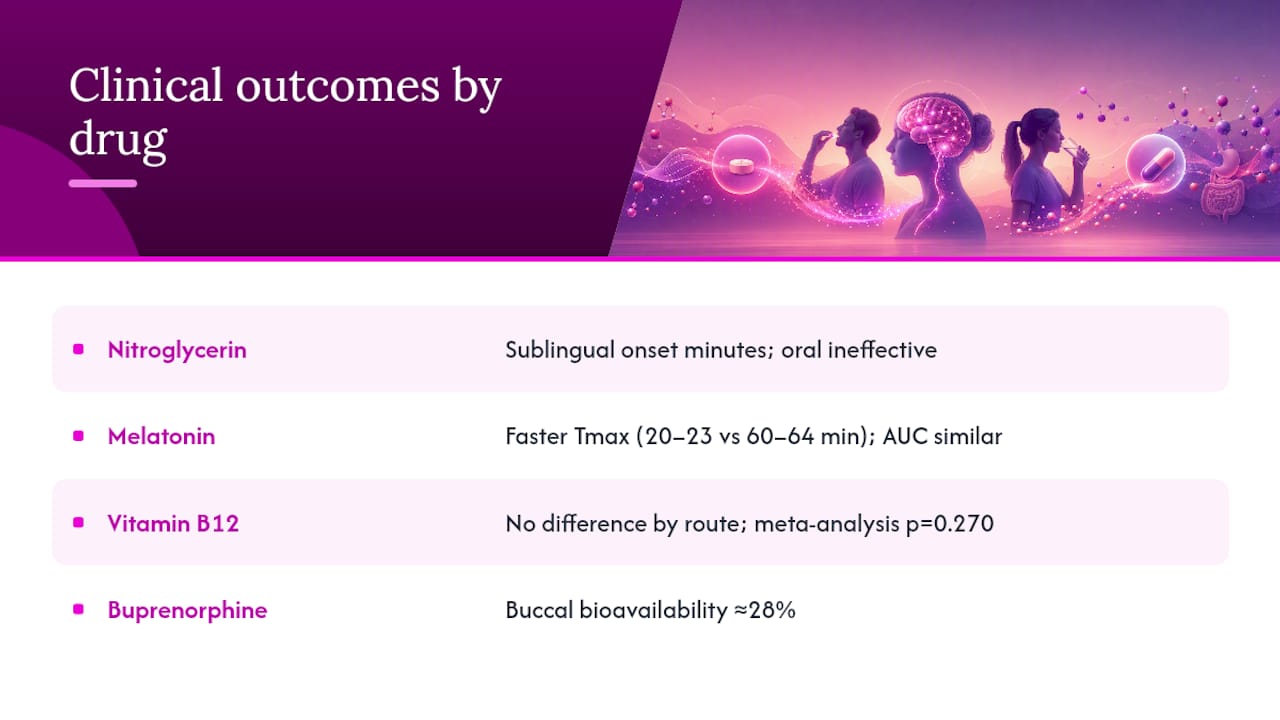
Nitroglycerin is the textbook case for a reason. Given sublingually during an angina attack, it reaches the bloodstream fast enough to relieve chest pain within minutes, a speed that matters enormously in an acute cardiac event. Oral nitroglycerin, by contrast, would be almost entirely destroyed by first-pass liver metabolism before it ever reached systemic circulation, which is exactly why it isn’t formulated that way. This is the cleanest example of a drug where the sublingual route isn’t a marginal improvement, it’s the only version of the drug that functions as intended.
Melatonin tells a more nuanced story. A crossover trial comparing an immediate-release sublingual spray to an oral prolonged-release tablet found the sublingual spray reached peak concentration in about 20 to 23 minutes, compared to roughly 60 to 64 minutes for the oral tablet. Cmax was also higher for the sublingual version. But total drug exposure, the AUC, came out similar between the two formats. Translation: the sublingual spray gets melatonin into your system faster and at a higher peak, useful if you want to fall asleep quickly, but it isn’t delivering meaningfully more total melatonin over time than the oral version.
Melatonin is a rare case where the clinical trial data actually separates speed from total exposure. Sublingual wins on Tmax and Cmax. Oral and sublingual end up roughly equal on AUC.
Vitamin B12 is the compound that most consistently undercuts the “sublingual is always better” narrative. A systematic review and meta-analysis covering 16 studies and 6,098 participants found no statistically significant difference in serum cobalamin increases between oral, sublingual, and intramuscular B12 administration (p=0.270). This surprises a lot of people, given how heavily “sublingual B12” is marketed for better absorption. The mechanistic explanation makes it less surprising, though: high-dose oral B12 relies on passive diffusion across the gut lining, which is inefficient (often cited around 1 to 2% absorption at high doses) but still delivers enough B12 to correct deficiency because the doses used are so large relative to what the body needs. Sublingual B12 doesn’t get a first-pass bypass advantage that matters much here, because oral B12 megadoses were never depending on efficient first-pass survival in the first place.
Buprenorphine and other buccal or sublingual analgesics round out the picture with a more mixed clinical reality. Buccal buprenorphine bioavailability sits around 28%, which is workable for a drug that would otherwise face nearly complete first-pass destruction if swallowed. That’s why opioid formulations like this are engineered specifically for mucosal delivery rather than adapted from an oral pill. Related PK trial work on midazolam and triazolam, discussed earlier, reinforces the same pattern: drugs with high first-pass loss show the biggest sublingual advantage, while drugs with decent oral bioavailability show a smaller, sometimes negligible, benefit.
Line these four examples up, and a pattern emerges that’s more useful than any blanket claim about sublingual superiority. The advantage tracks almost exactly with how much a drug loses to first-pass metabolism when swallowed, not with the sublingual route itself as some universally superior delivery method.
When Sublingual Delivery Makes Sense and When Oral Is Fine
Turning all of this into a decision isn’t complicated once you know what to check. Ask these questions before assuming sublingual is the “upgraded” version of anything you’re taking.
- Does the compound face heavy first-pass metabolism when swallowed? If yes, sublingual has a real mechanistic case. If the drug already has strong oral bioavailability, the upside shrinks fast.
- Do you need rapid onset for an acute situation? Angina relief, acute anxiety, or fast-acting sleep support are scenarios where Tmax genuinely matters, not just total exposure.
- Do you have a condition affecting GI absorption or swallowing? Malabsorption, dysphagia, or significant GI motility issues can make a non-swallowed route more reliable regardless of first-pass considerations.
- Is there actual PK or clinical data behind the specific product’s claim? A brand citing a real Tmax or AUC comparison is a very different claim than one just asserting “better absorption.”
- Are you using it correctly? Holding the dose under the tongue for the full dissolution time, without eating, drinking, or swallowing early, is where a lot of real-world sublingual products lose their theoretical advantage.
Safety matters just as much as efficacy here. Avoid sublingual products that rely on unregulated penetration enhancers with no disclosed safety data behind them. Follow labeled dosing instructions closely, since faster absorption can mean a faster and more pronounced peak effect, which matters more for drugs with a narrow therapeutic window. And for anyone on prescription medication, especially ones where small changes in absorbed dose have real consequences (blood thinners, thyroid medication, seizure medication), talk to a clinician before switching formats. Levothyroxine in particular is notoriously sensitive to absorption changes, and switching delivery routes without medical guidance isn’t something to improvise.
Pro Tip: If a product’s absorption claim doesn’t mention a specific pharmacokinetic study or comparison, treat it as a design philosophy, not proven superiority. “Formulated for sublingual absorption” describes intent. A cited Tmax or AUC comparison describes evidence.
Why Absorption Studies Disagree With Each Other
A lot of the confusion around sublingual versus oral absorption comes from real methodological differences between studies, not just marketing spin.
Dose and formulation vary widely between trials, so a sublingual spray in one study and a sublingual tablet in another aren’t really testing the same delivery mechanism, even though both get labeled “sublingual.” Small sample sizes are common in PK research, which means a study showing a dramatic percentage difference between routes might be describing a handful of participants rather than a robust population effect. Crossover trial designs, where the same participants try both routes, generally produce cleaner comparisons than parallel designs with separate groups, but even crossover studies can’t fully control for how consistently each person followed dosing instructions.
That last point matters more than most people assume. Whether someone actually held a dose under the tongue for the full period, how much saliva diluted it, and basic interindividual variability in mucosal thickness or blood flow all shift results in ways that are hard to standardize.
- Dose and formulation differences make cross-study comparisons unreliable without careful reading.
- Small sample sizes can exaggerate apparent differences between routes.
- Behavioral adherence, not swallowing too early, avoiding food or drink, affects real-world results more than lab conditions suggest.
- Statistical significance and clinical significance aren’t the same thing. A meta-analysis showing “no significant difference” (like the B12 data) doesn’t mean zero difference exists for every individual, just that the pooled evidence doesn’t support a reliable population-level advantage.
How Nukalove Designs Around Real Absorption Science
Nukalove builds oral strips with these pharmacokinetic principles in mind, not as an afterthought. Rapid dissolution, safe and well-tolerated excipients, and clear usage instructions are all formulation choices that directly affect how much of a dose actually gets a chance to absorb rather than getting swallowed prematurely. The strip format itself is a deliberate answer to a real problem: pills are easy to forget, hard to dose consistently on the road, and don’t offer the fast-dissolving contact time that mucosal absorption depends on.
For deeper background on how sublingual and oral supplement absorption compares nutrient by nutrient, Nukalove’s guide to sublingual vitamins covers the evidence in more detail. None of this replaces medical advice: talk to a clinician before changing any prescription medication routine, especially for drugs with narrow therapeutic windows.
Why Reliable Absorption Matters More Than Marketing Claims
Absorption reliability isn’t an abstract science question if you’re dealing with a hot flash at 30,000 feet or trying to fall asleep in a hotel room three time zones from home. It’s the difference between a product that works when you need it and one that just sounds good on the label. That’s the standard worth holding every supplement claim to, sublingual or otherwise.
Evidence-based formulation and honest labeling matter more than trend-driven claims about “superior absorption.” The B12 data alone should make anyone skeptical of blanket statements about sublingual superiority. Where the science supports a real advantage, as it does for fast-acting compounds facing heavy first-pass loss, that’s worth building around. Where it doesn’t, convenience and reliable dosing are still legitimate reasons to choose a format, just not reasons dressed up as pharmacokinetic superiority they haven’t earned.
If you’re on any prescription medication, loop in your clinician before switching how you take it.
— NUKA
Try an Oral Strip Built for Fast, Reliable Absorption
Nukalove makes the case for sublingual-style delivery easy to act on instead of just read about. Every strip is built to dissolve quickly under the tongue, so you’re not carrying pill bottles through airport security or fumbling with water on a red-eye flight. The GLOW GETTER oral strips target skin and hair support in the same fast-dissolving format, while DEEP ZZZS oral sleep strips apply the same rapid-dissolution approach to nighttime support, and CLARITY focus strips use functional mushrooms like lion’s mane and cordyceps in the same travel-ready format.
None of these are framed as medication, and none claim to outperform a specific drug’s absorption profile. What they offer is a format built around the same principles this article covers: rapid disintegration, no water required, and a dose you can take discreetly between meetings or mid-flight. If convenience and dissolution speed matter to how consistently you actually take something, browse the full product lineup and find the strip that fits your routine.
Sources
- Chapter: Routes of drug administration and absorption (NCBI Bookshelf)
- Comparative PK studies (PubMed reference)
- Sublingual and Buccal Delivery: A Historical and Scientific Prescriptive (Pharmaceutics 2025)
This article is general information, not a substitute for advice from a qualified doctor. Consult a qualified healthcare professional about your own circumstances before acting on anything here.