

3 Travel Tested Moves for Menopause Sleep on Flights
Control cabin temperature, hydrate like it’s your job, and pack a dedicated sleep kit. Those three moves solve most in-flight sleep problems tied to menopause. If you use melatonin, keep the dose short and clinician-approved, timed to your destination bedtime. Travel-tested advice backs this up: preparation, not luck, determines whether you land rested.
TL;DR:
- Staying hydrated and avoiding alcohol or caffeine before flights helps reduce hot flashes and sleep disturbances caused by dehydration and temperature spikes.
- Choosing an aisle seat and using cooling accessories like fans or towels can quickly lower body temperature and improve sleep quality during flight.
- Short-term melatonin can aid circadian adjustment if timed correctly and dosed at 1 to 3 milligrams, but long-term use is not recommended without medical supervision.
- Pre-flight preparation, such as gradually shifting sleep schedules, ensuring hotel room temperature control, and building in recovery time, minimizes jet lag and sleep issues.
- Packing a dedicated sleep kit with eye masks, earplugs, layered clothing, medications, and hydration tools helps manage menopausal symptoms and environmental triggers on the go.
Table of Contents
- What’s the Best Way to Manage Menopause Sleep on Flights?
- Before You Fly: Preparation That Actually Changes Your Sleep
- In-Flight Strategies That Actually Work
- Melatonin, Sleep Aids, and HRT: What to Know Before You Board
- How to Recover From Jet Lag During Menopause
- How Do You Calm Flight Anxiety Enough to Sleep?
- What Should Be in Your Menopause Travel Sleep Kit?
- Why NUKA’s Travel Advice Comes From Real Flight Experience
- A Few Honest Words on Menopause Travel Anxiety
- Travel-Ready Sleep Support You Can Pack in a Pocket
- Sources
- FAQ
What’s the Best Way to Manage Menopause Sleep on Flights?
There isn’t one trick that fixes menopause sleep on flights. It’s a stack of small decisions, each one canceling out a specific trigger before it derails you.
Here’s the pre-flight and boarding checklist that handles the most common disruptors: heat, dehydration, noise, and disorganized medication.
- Choose an aisle seat for movement and air access, or a window seat if you need something to lean on for head support.
- Ask about upgrading to extra legroom if your budget allows. Cramped knees make hot flashes feel worse.
- Hydrate heavily starting the night before. Skip alcohol and cut caffeine after midday on travel day.
- Pack a compact sleep kit: eye mask, earplugs or noise-canceling headphones, a lightweight layer system, a portable fan or cooling towel, a refillable water bottle, and electrolyte sachets.
- Keep hormone replacement therapy (HRT) or other medications in your carry-on with prescription labels intact, not checked luggage.
- If you’re crossing more than two time zones, start shifting your bedtime by 30 minutes a day for two to three days before departure.
None of this requires special gear you can’t find at a drugstore or already own. The point is having it all in one place so you’re not digging through a bag at 35,000 feet while a hot flash builds.
Before You Fly: Preparation That Actually Changes Your Sleep
Menopausal sleep is already fragile. Hormonal fluctuations disrupt sleep architecture and increase night wakings even at home, according to a peer-reviewed evidence review. Add jet lag on top of that, and recovery takes longer than it used to in your 30s.
- Shift your sleep schedule gradually. Move bedtime and wake time by 30-minute increments starting two to three days before a multi-time-zone flight. Menopausal circadian rhythms often re-entrain more slowly than they did before, so a gentler ramp beats a sudden jump.
- Lock in medication logistics early. Keep HRT dosing consistent leading up to travel. Talk to your clinician about whether dose timing should shift for your new time zone, and always carry prescriptions in their original packaging.
- Vet your hotel before you book. Call or check reviews for the lowest thermostat setting, whether the windows open, and if portable fans are available on request. A room that can’t get cold enough will wreck a night’s sleep faster than jet lag ever could.
- Book a refundable first night. If the room runs hot and there’s no fix, you want the option to move without eating the cost.
- Build in a recovery day. Skip scheduling anything demanding for your first full day after landing. Sleep debt from the flight needs somewhere to resolve.
Small logistics, done a few days out, prevent the kind of sleep deficit that takes a week to climb out of.
In-Flight Strategies That Actually Work
Cabin air runs dry and warm, which is close to the worst combination for someone managing hot flashes. Sleep disruption in midlife comes from overlapping causes, including thermoregulation, hormones, and stress, and a plane cabin can trigger all three at once.
Temperature control comes first. Dress in layers you can strip off in seconds. Take your shoes off once you’re settled. A small battery-powered fan or a cooling towel pressed to your wrists or neck cools your blood fast, since those are pulse points close to the skin’s surface.
Hydration matters more than people think. Cabin humidity sits lower than a desert, which worsens both hot flashes and grogginess. Drink water steadily through the flight, and skip the wine. Alcohol widens blood vessels and can trigger flashes, while it also fragments the sleep you do manage to get, a pattern travel sleep experts consistently flag.
Seat choice is a thermal decision, not just a comfort one. An aisle seat gives you room to stand, stretch, and reach the galley for cold water. A window seat gives you a wall to lean on, but it can trap heat against your body during a flash. Pick whichever helps you cool down fastest, because that’s the real variable.
Noise and light control seals the deal. An eye mask, earplugs or noise-canceling headphones, and a calming audio track or guided sleep session cut down the sensory noise that keeps your brain alert.
- Wash your face and change into a fresh layer before attempting sleep, the way you’d cue a bedtime routine at home.
- Avoid your phone or tablet for 30 to 60 minutes before you try to sleep.
- Consider 1 to 3 milligrams of melatonin only if it’s timed to your destination’s bedtime and your clinician has signed off.
Pro Tip: Keep a second, thinner layer folded in your seatback pocket. Hot flashes don’t wait for a convenient moment, and reaching overhead for your bag mid-flash wakes you up more than the flash itself.
Melatonin, Sleep Aids, and HRT: What to Know Before You Board
Melatonin can genuinely help realign your body clock, but timing is everything. Clinical research on sleep disorders shows it works best as a short-term tool, dosed close to your destination’s bedtime, rather than something you take indefinitely.
- Stick to low doses (1 to 3 milligrams) for two to three nights, no longer, unless a clinician says otherwise.
- Be cautious mixing alcohol with benzodiazepines or other sedative-hypnotics on a flight. The combination can suppress breathing and deepen impairment in ways that are hard to catch midair.
- Never skip an HRT dose to “save it” for later. Continuity matters more than perfect timing, so talk to your clinician in advance if you’re crossing time zones and need to adjust when you take it.
- Keep all medications in original, labeled containers in your carry-on. The TSA allows medically necessary liquids and medications in reasonable quantities beyond the standard 3-1-1 limit, but they need to be declared at the checkpoint.
Magnesium is worth a mention here too. Some research points to magnesium supplementation easing anxiety symptoms in certain people, which makes it a reasonable adjunct for the stress side of travel sleep loss, though it’s not a substitute for addressing hormonal causes directly with your clinician.
How to Recover From Jet Lag During Menopause
Getting to your destination is only half the job. Recovery determines whether the trip actually feels restful.
- Start your pre-trip shift early. Menopausal bodies often re-entrain more slowly than they used to, so give yourself extra runway compared to what worked for you a decade ago.
- Get outside within 90 minutes of waking. Daylight exposure combined with light activity, even just a walk, resets your circadian clock faster than staying indoors.
- Use melatonin only for the first two to three nights, dosed at 1 to 3 milligrams and timed to your new local bedtime. Continuous use past that window works against you rather than for you.
- Protect a recovery day. Save heavy sightseeing for day two or three. Your first day should be light on obligations and heavy on sleep debt repayment.
Travel checklists built for menopausal travelers consistently point back to the same core moves: temperature control, hydration, and pacing outperform anything fancier.
How Do You Calm Flight Anxiety Enough to Sleep?
Anxiety and physical symptoms feed each other on a plane. A hot flash spikes your heart rate, which can trigger anxiety, which then makes it harder to cool down or relax enough to sleep.
- Try box breathing: inhale for four counts, hold for four, exhale for four, hold for four. Repeat five or six cycles.
- Progressive muscle relaxation works well in a seat: tense and release each muscle group from your feet upward.
- A sleep or meditation app queued up before takeoff gives your mind something structured to follow instead of spiraling.
- If flying anxiety has been a recurring problem, talk to your clinician about short-term options or cognitive behavioral strategies built specifically for flight anxiety.
- Choose an aisle seat if anxiety is a factor. Being able to stand and move without asking permission reduces the trapped feeling that often triggers panic.
What Should Be in Your Menopause Travel Sleep Kit?
Keep everything in a single pouch so boarding chaos doesn’t scatter your supplies.
- Eye mask, earplugs or headphones, and a travel pillow for basic sleep setup.
- Cooling towel or a small battery fan for hot flash management mid-flight.
- Refillable water bottle and electrolyte sachets to fight cabin dehydration.
- Layered clothing you can add or remove in seconds.
- Prescription medications, including HRT, in their original labeled containers.
- Optional extras: pocket oral strips, a small cooling gel pack, a spare sleep layer, and a travel-size moisturizer for dry cabin skin.
Zip it all into one pocket of your carry-on. You want to reach for it without unpacking your whole bag at 2 a.m. somewhere over the Atlantic.
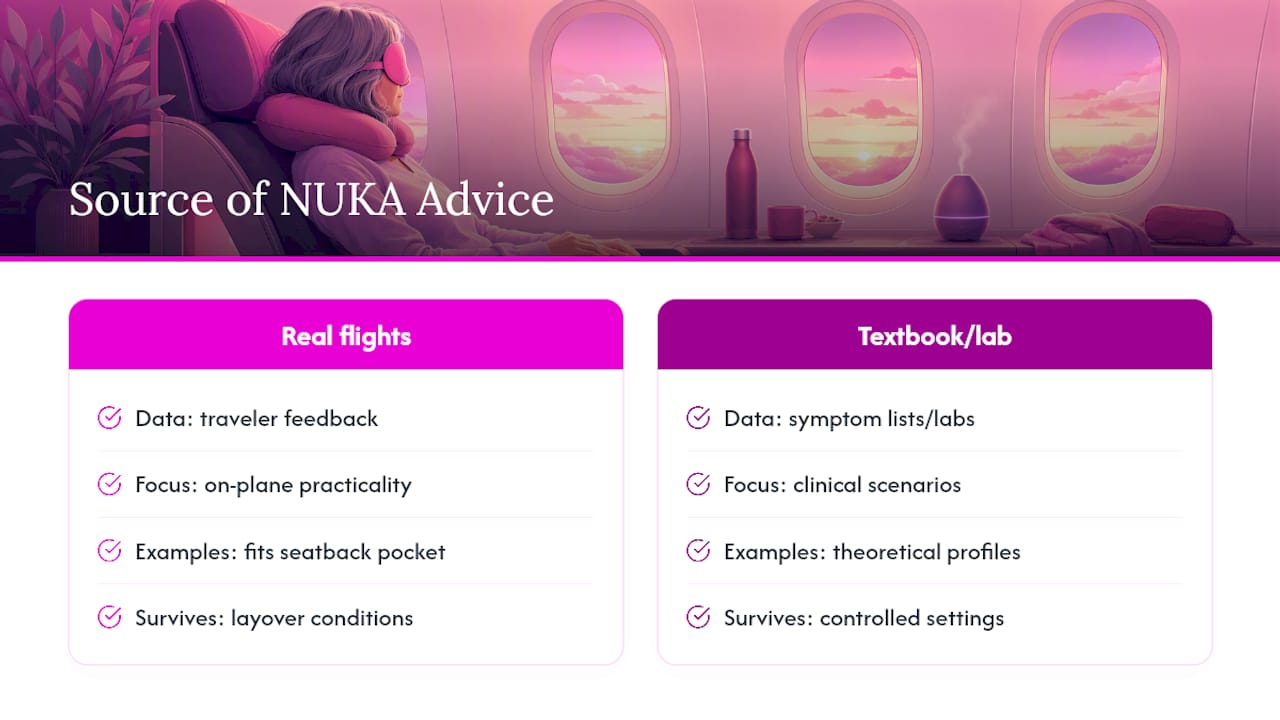
Why NUKA’s Travel Advice Comes From Real Flight Experience
NUKA built its menopause jet lag guidance and hot flash on-plane tactics around what actually happens to women mid-flight, not textbook symptom lists. Product testing draws on real traveler feedback about what fits in a seatback pocket and what survives a layover, not lab conditions alone.
A Few Honest Words on Menopause Travel Anxiety
If flying already stressed you out, menopause adds a second layer most people don’t warn you about. That’s normal, not a personal failing. The women who travel best through this stage aren’t the ones who never have a rough flight. They’re the ones who’ve built small, boring habits, like packing the same sleep kit every time, that quietly prevent most disruptions before they start. If you’re anxious about a big trip, test your checklist on a short flight first. Confidence builds fast once you see it actually works.
Travel-Ready Sleep Support You Can Pack in a Pocket
A sleep kit solves the environment. Sometimes you also want something small for the wind-down itself, which is where DEEP ZZZS™ oral sleep strips come in, launching soon from NUKA. They’re built in the same compact oral strip format as the rest of the lineup, meaning no water, no pills to fumble with in a dark cabin, just a strip that dissolves and slides into your existing pre-sleep routine. Think of it as one more tool in the kit alongside your fan and your layers, useful for short-term, on-the-go support rather than a replacement for anything your clinician has prescribed. Pair it with GLOW GETTER skin strips if dry cabin air tends to hit your skin as hard as your sleep. Check the NUKA product lineup to see what’s available now and get notified the moment DEEP ZZZS™ ships.
Sources
- Sleep and menopause: evidence review
- Menopause and sleep: a review of causes and treatments
- Magnesium for anxiety — Cleveland Clinic
- Menopause-friendly travel ideas: a practical checklist for sleep, temperature, and stress
FAQ
Does Menopause Insomnia Go Away?
For many women, sleep improves after the postmenopausal transition stabilizes hormone levels, though timing varies widely. Consistent habits, like the temperature and hydration strategies covered above, tend to shorten how long the rough stretch lasts.
Is It Normal to Wake Up at 4 a.m. During Perimenopause?
Yes. Early morning waking is one of the most commonly reported sleep disruptions during perimenopause, tied to fluctuating hormone levels affecting sleep architecture.
Can High Estrogen Levels Cause Insomnia?
Both high and low estrogen swings during perimenopause can disrupt sleep, since it’s the fluctuation itself, not one direction, that tends to interfere with normal sleep cycles.
Can Melatonin Help With Menopause Insomnia?
Melatonin can help with circadian realignment, particularly around travel and jet lag, when used short-term at low doses and timed to your target bedtime. It’s not designed for nightly long-term use, so check with your clinician before making it a habit.