

Melatonin Side Effects in Women: What You Need to Know
For most women, melatonin side effects are mild and short-lived. The most common complaints — daytime drowsiness, headache, and nausea — show up in a small fraction of users in clinical trials, and serious reactions are rare. That said, certain groups need to pause before reaching for the bottle: pregnant and breastfeeding women, anyone on blood thinners or CNS depressants, and women managing autoimmune conditions or seizure disorders should talk to a clinician first.
One more thing worth knowing upfront: in the United States, melatonin is sold as an unregulated dietary supplement, not an FDA-approved drug. That means dosing, purity, and quality vary widely by brand.
When to act fast: Stop melatonin immediately and call 911 if you experience difficulty breathing, collapse, chest pain, or severe confusion. For persistent drowsiness, mood changes, or headaches that don’t resolve, contact your clinician within a few days.
- Mild side effects (drowsiness, headache, nausea) are the most common
- Serious reactions are rare, occurring in fewer than 1 in 1,000 people
- Melatonin is not FDA-approved as a drug in the U.S. — supplement quality varies
- Pregnant and breastfeeding women should avoid it without clinician guidance
Key Takeaways
Melatonin side effects in women are typically mild and short-lived, but dose, timing, formulation, and individual health status all determine how much risk you’re actually taking on.
| Point | Details |
|---|---|
| Side effects are usually mild | Daytime drowsiness (slightly higher than 1%) and headache/dizziness (slightly less than 1%) are the most common in trials; serious reactions are rare. |
| Certain groups should avoid it | Pregnant, breastfeeding, and women with liver, kidney, or autoimmune conditions need clinician guidance before use. |
| Dose and timing matter | Start at 0.5–1 mg; take 30–45 minutes before bed for sleep onset; extended-release raises next-day grogginess risk. |
| Check product quality | Choose supplements with USP, NSF, or ConsumerLab certification — melatonin is unregulated in the U.S. and label accuracy varies. |
| Nukalove offers a melatonin-free option | DEEP ZZZS™ oral sleep strips provide sleep support without melatonin, designed for women and convenient for travel. |
Table of Contents
- What are the most common melatonin side effects in women?
- Rare but serious side effects: what to watch for
- Who should avoid melatonin or use it only with medical advice?
- Drug and supplement interactions women should know about
- How dose, timing, and formulation affect side effects
- What long-term studies say — and what’s still unknown
- Female-specific considerations: pregnancy, fertility, and menopause
- When to stop melatonin and see a doctor
- How to reduce side-effect risk if you decide to try melatonin
- What women-focused clinicians say about melatonin and alternatives
- Sources
What are the most common melatonin side effects in women?
The short answer: most women who try melatonin don’t experience anything dramatic. Systematic reviews of randomized controlled trials report that daytime sleepiness occurred at a rate slightly higher than 1% and headache or dizziness slightly less than 1% — rates that were low and close to placebo. That’s a reassuring signal, though most of those trials ran for fewer than 12 weeks, so they don’t tell us much about long-term daily use.
Here’s what women most commonly report:
| Side Effect | Approximate Frequency (Trial Data) | Notes |
|---|---|---|
| Daytime drowsiness / grogginess | slightly higher than 1% | Most common; dose- and timing-dependent |
| Headache / dizziness | slightly less than 1% | Often resolves with dose reduction |
| Nausea | Low; exact rate varies by trial | More likely at higher doses |
| Vivid dreams / nightmares | Reported in trials; rate varies | More common with extended-release |
| Stomach cramps | Occasional | Usually mild and transient |
| Mood changes / irritability | Rare in trials | Monitor if you have a mood history |
Statistic to know: In a systematic review of melatonin RCTs, adverse-event rates were low and similar to placebo across most trials — yet doses ranged from 0.15 mg to 15 mg, which is a wide spread that makes direct comparisons tricky.
Practical steps you can take right now:
- Start at the lowest available dose (0.5 mg or 1 mg) and only increase if needed
- Take melatonin 30–45 minutes before bed for sleep onset, not hours earlier
- Skip alcohol on nights you take it — alcohol amplifies sedation
- Don’t drive or operate machinery if you feel groggy the next morning
- If you take oral contraceptives, know that they can slow melatonin clearance, which may intensify effects
Melatonin’s effects typically last 4 to 8 hours, so timing your dose poorly — say, taking it mid-evening when you plan to be up late — can leave you foggy the next morning. That “melatonin hangover” is almost always a dose or timing problem, not an unavoidable side effect.
Rare but serious side effects: what to watch for
Serious reactions to melatonin are uncommon. The NHS describes them as occurring in fewer than 1 in 1,000 people, and most clinical reports involve very high doses or individuals with pre-existing vulnerabilities.
Call 911 immediately if you experience any of the following:
- Difficulty breathing or throat tightening (signs of anaphylaxis)
- Collapse or loss of consciousness
- Chest pain or severe palpitations
- Severe confusion or disorientation
- Sudden vision changes
Case reports document overdose scenarios involving severe drowsiness, confusion, and low blood pressure, but melatonin has very low acute toxicity and most treatment is supportive. In other words, the supplement itself is unlikely to cause catastrophic harm at typical doses, but combining it with alcohol, sedatives, or other CNS depressants raises the risk profile considerably.
Seek urgent (non-emergency) care if you notice:
- A skin rash, hives, or facial swelling after taking melatonin
- Fainting or near-fainting episodes
- Significant blood pressure changes (relevant if you’re on antihypertensives)
- Worsening depression or new psychiatric symptoms
Allergic reactions, while rare, do happen. If you’ve had reactions to other supplements, start with a very small test dose and wait 30 minutes before taking the full amount.
Who should avoid melatonin or use it only with medical advice?
Some women should not take melatonin without a clinician’s sign-off, regardless of how mild the general side-effect profile looks. Here’s who falls into that category and why:
- Pregnant women: Safety data are insufficient. StatPearls clinical guidance recommends avoidance during pregnancy because melatonin crosses the placenta and its effects on fetal development are not well characterized.
- Breastfeeding women: Melatonin passes into breast milk. The same clinical guidance advises against use without direct clinician supervision.
- Women with liver disease: The liver metabolizes melatonin via CYP1A2 enzymes. Impaired liver function slows clearance, raising blood levels and side-effect risk.
- Women with kidney disease or on dialysis: Reduced kidney function can affect how long melatonin stays active in the body. The Sleep Foundation explicitly flags this group for clinician consultation.
- Women with autoimmune conditions: Melatonin has immunomodulatory properties. In conditions like lupus or rheumatoid arthritis, it could theoretically stimulate immune activity — a concern worth discussing with a rheumatologist.
- Women with seizure disorders: Some evidence suggests melatonin may lower the seizure threshold in certain individuals; neurologist guidance is warranted.
- Women with severe depression or other psychiatric conditions: Mood effects, though rare, have been reported. Anyone with a psychiatric history should loop in their prescriber before adding melatonin.
When you talk to your clinician or pharmacist, bring:
- A full list of your current medications and supplements
- The dose and formulation you’re considering (or already tried)
- Your timing and how long you’ve been using it
- A brief description of any symptoms you’ve noticed
That conversation takes five minutes and can prevent a lot of unnecessary guesswork.
Drug and supplement interactions women should know about
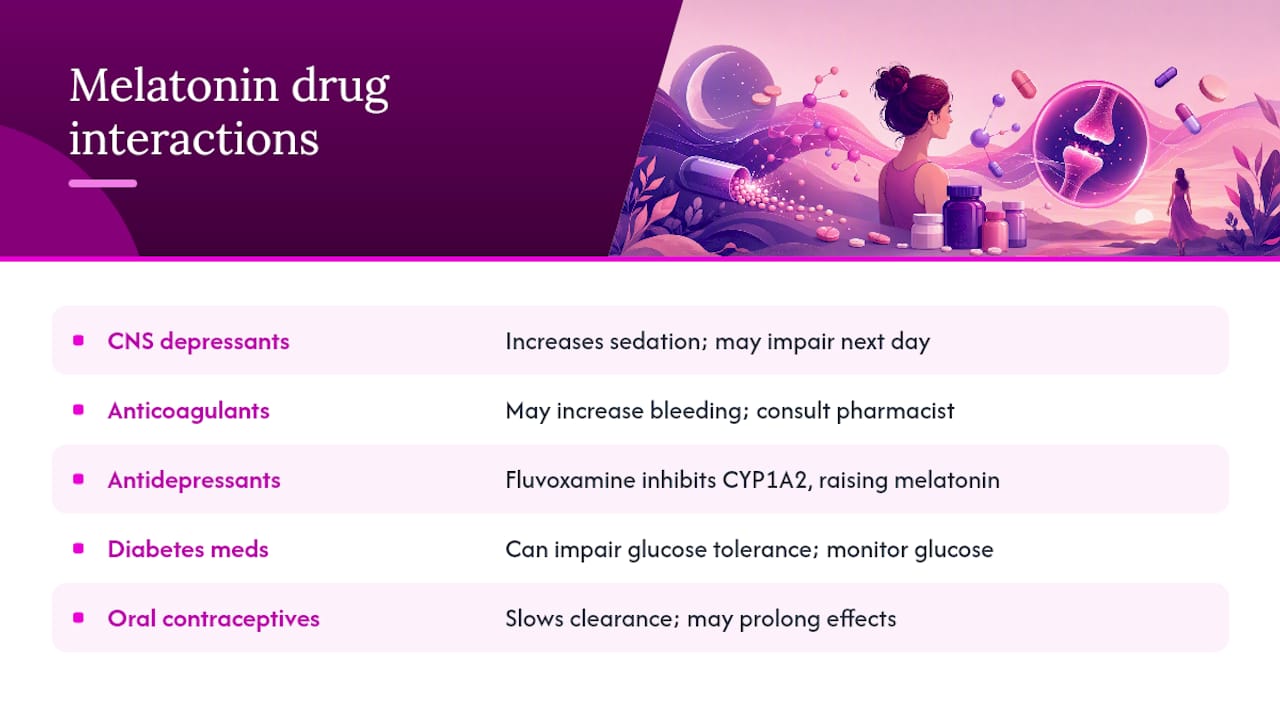
Melatonin doesn’t interact with everything, but the interactions it does have are worth taking seriously. Several common medication classes are relevant for women, particularly those managing menopause, chronic conditions, or mental health.
CNS depressants and alcohol are the most immediate concern. Combining melatonin with benzodiazepines, sleep aids like zolpidem, opioids, or even antihistamines can compound sedation to a degree that impairs next-day function or, at higher doses, becomes dangerous. Alcohol does the same thing and also disrupts sleep architecture — so it works against the very goal you’re taking melatonin for.
Blood thinners (anticoagulants) like warfarin interact with melatonin in ways that may alter bleeding risk. The mechanism isn’t fully established, but the signal is consistent enough that anyone on anticoagulation therapy should get pharmacist clearance before starting melatonin.
Some antidepressants — particularly fluvoxamine — significantly inhibit the CYP1A2 enzyme that breaks down melatonin. That can cause melatonin levels to spike far above what the label dose suggests, intensifying both effects and side effects. SSRIs and SNRIs carry a more modest interaction risk, but it’s still worth flagging to your prescriber.
Anticonvulsants like carbamazepine can speed up melatonin metabolism, potentially reducing its effectiveness. Conversely, melatonin may affect seizure threshold in some individuals, making this a two-way concern.
Diabetes medications deserve attention because melatonin can impair glucose tolerance in some people. If you’re managing blood sugar with metformin, insulin, or other agents, monitor glucose more closely when you start melatonin and report any changes to your clinician.
Oral contraceptives slow melatonin clearance, which means the same dose may produce stronger or longer-lasting effects in women on hormonal birth control. Starting at a lower dose makes particular sense in this group.
Pro Tip: Before starting melatonin, run your full medication list by a pharmacist — not just your prescriber. Pharmacists are specifically trained in drug interactions and can flag issues in minutes that might otherwise take weeks to surface clinically.
How dose, timing, and formulation affect side effects
The dose printed on a melatonin bottle is often far higher than what your body actually needs. Your brain’s pineal gland produces roughly 0.3 mg of melatonin per day under normal conditions. Many over-the-counter supplements contain 1 mg to 10 mg — and some go higher. That gap between endogenous production and supplement dose is a big reason why side effects like next-day grogginess and vivid dreams are so common.
Immediate-release vs. extended-release
| Feature | Immediate-Release | Extended-Release |
|---|---|---|
| Onset | Fast (30–45 min) | Slower, gradual |
| Duration | Shorter; mirrors natural peak | Longer; sustained through night |
| Best for | Trouble falling asleep | Trouble staying asleep |
| Grogginess risk | Lower if timed well | Higher; morning levels may remain elevated |
| Dose sensitivity | More predictable | Harder to titrate |
Extended-release formulations are more likely to cause morning grogginess because melatonin levels can remain elevated past your natural wake time. If you’re already struggling with melatonin next day grogginess, switching to immediate-release at a lower dose is usually the first fix to try.
Timing protocols
UC Davis Health guidance distinguishes two different use cases with different timing rules:
- For sleep onset (you want to fall asleep faster tonight): take melatonin 30–45 minutes before your target bedtime.
- For circadian phase-shifting (jet lag, shift work, delayed sleep phase): take it 3–4 hours before your target sleep time. This is a different protocol entirely, and using the sleep-onset timing for a circadian goal — or vice versa — can cause unwanted phase shifts or grogginess.
Pro Tip: Start with 0.5 mg or 1 mg on alternate nights rather than nightly. If that dose works, you’ve found your floor — and a lower dose means fewer side effects and less risk of dependence on a supplement to fall asleep.
What long-term studies say — and what’s still unknown
The honest answer is that long-term safety data for melatonin is thin. Systematic reviews consistently find low adverse-event rates in randomized controlled trials, but most of those trials ran for fewer than 12 weeks. The doses tested ranged from 0.15 mg to 15 mg, making it difficult to draw firm conclusions about any specific dose over time.
A few important gaps:
- Very few studies follow participants beyond three months of nightly use
- Most trials don’t stratify results by sex, so female-specific long-term data is limited
- Trials are generally underpowered to detect rare events
- Pregnancy-specific safety studies are nearly absent
What the evidence does support: occasional, short-term melatonin use appears to carry low risk for most healthy adults. The side-effect profile in trials is mild and similar to placebo. Where the evidence gets thin is nightly use over months or years — that’s territory where clinician oversight matters.
StatPearls notes that melatonin is relatively nontoxic, but flags that higher doses and extended-release formulations carry greater risk of mild adverse effects. The practical implication: if you’ve been taking melatonin nightly for more than a few weeks without reassessing, that’s a conversation worth having with your doctor.
Female-specific considerations: pregnancy, fertility, and menopause
Pregnancy and breastfeeding
This is the clearest guidance in the literature: avoid melatonin during pregnancy and breastfeeding unless a clinician specifically directs otherwise. Safety data are insufficient, melatonin crosses the placenta, and it passes into breast milk. Both StatPearls and the Sleep Foundation align on this point. If you’re struggling with sleep during pregnancy, a clinician can suggest safer options — CBT-I (Cognitive Behavioral Therapy for Insomnia) being the most evidence-backed.
Fertility and menstrual cycle
Current evidence on melatonin’s effects on reproductive hormones is limited and inconclusive. In humans, the picture is far less clear. Women trying to conceive should discuss melatonin use with their OB-GYN before starting, particularly at higher doses.
Perimenopause and menopause
This is where the research gets genuinely interesting. Melatonin production declines with age, and that decline accelerates around menopause — which may partly explain why sleep disruption is so common during this transition. Research published in the Journal of Pineal Research explores melatonin’s role beyond sleep in menopausal women, including antioxidant effects, reproductive system interactions, and possible bone-health signals. The evidence is mixed and dose-specific; no clinical guidelines currently recommend melatonin as a standard menopause treatment.
For perimenopausal women with sleep disruption, melatonin may offer modest benefit — particularly for sleep onset. But the dose used in trials showing benefit tends to be low (1–3 mg), and the effect size is modest. For women whose sleep problems are driven primarily by hot flashes or night sweats, melatonin addresses the symptom (difficulty sleeping) without touching the cause. Exploring perimenopause supplements that address the underlying hormonal shifts may be more effective for that group.
When to stop melatonin and see a doctor
Some situations call for a 911 call. Others call for a scheduled appointment. Knowing which is which saves time and potentially prevents harm.
Call emergency services immediately if you experience:
- Difficulty breathing or throat swelling
- Loss of consciousness or collapse
- Chest pain or severe heart palpitations
- Sudden severe confusion or inability to speak clearly
- Signs of severe allergic reaction (hives spreading rapidly, face/tongue swelling)
Contact your clinician within a few days if you notice:
- Daytime drowsiness that persists beyond the first week and affects your work or driving
- New or worsening depression, anxiety, or mood instability
- Recurrent severe headaches that started after beginning melatonin
- Blood sugar readings that are unexpectedly high or low (if you’re diabetic)
- Any symptom you suspect is linked to a drug interaction
Before your appointment, note down:
- The exact dose and formulation you’ve been taking
- What time you take it and how long you’ve been using it
- All other medications and supplements you’re on
- A brief timeline of when symptoms started relative to starting melatonin
That information helps your clinician make a faster, more accurate assessment.
How to reduce side-effect risk if you decide to try melatonin
Before you start
- Review your full medication list with a pharmacist, specifically asking about melatonin interactions
- Confirm your liver and kidney function are normal if you have any underlying health conditions
- Choose the lowest available dose (0.5 mg or 1 mg immediate-release)
- Look for products with third-party testing verification — USP, NSF International, or ConsumerLab certification means the label dose is accurate and the product is free of common contaminants
- Avoid melatonin entirely if you’re pregnant, breastfeeding, or trying to conceive without clinician guidance
The night you take it
- Take it 30–45 minutes before your target bedtime (not hours earlier)
- Skip alcohol completely that evening
- Don’t combine with other sleep aids, antihistamines, or sedatives unless your clinician has approved the combination
- Arrange not to drive the next morning until you know how it affects you
- Note any unusual dreams, mood shifts, or physical symptoms
Ongoing monitoring
- Keep a simple 1–2 week log: sleep onset time, wake time, how you feel in the morning, and any side effects
- If you notice next-day grogginess, reduce the dose before changing the timing
- Stop immediately and contact your clinician if you experience severe or persistent symptoms
- Reassess after 4 weeks — if melatonin isn’t helping your sleep, continuing it indefinitely isn’t the answer
What women-focused clinicians say about melatonin and alternatives
Clinicians who specialize in women’s health and sleep medicine tend to frame melatonin as a short-term tool, not a long-term solution. UC Davis Health notes that melatonin is a hormone and should not be the first-line approach — sleep hygiene and behavioral measures are the recommended foundation before adding any supplement.
But the evidence base is still developing, and no major clinical body has issued a formal recommendation for melatonin as a menopause treatment.
Evidence-informed alternatives worth considering:
- CBT-I (Cognitive Behavioral Therapy for Insomnia): The most evidence-backed treatment for chronic insomnia, with durable results that outlast any supplement
- Sleep hygiene: Consistent wake time, dark and cool bedroom, no screens 60 minutes before bed — these are foundational and free
- Magnesium glycinate or magnesium threonate: Emerging evidence for sleep quality improvement, particularly relevant for menopausal women; see magnesium for sleep options for a practical overview
- Timed light exposure: Morning bright light (10–30 minutes outdoors or with a light therapy lamp) helps anchor circadian rhythm, which is often disrupted during perimenopause
- Melatonin-free supplement formats: For women who want sleep support without hormonal interference, sleep supplements without melatonin offer alternatives worth exploring
When to seek a sleep specialist: if insomnia has persisted for more than three months, is affecting your daytime function, or is accompanied by symptoms like gasping during sleep (possible sleep apnea), a referral to a sleep medicine specialist is warranted. Melatonin won’t fix structural sleep disorders.
A note from Nukalove on sleep and safety
At Nukalove, we’re a women-owned brand built around one premise: women deserve clear, honest information about what they’re putting in their bodies, especially during the hormonal shifts of perimenopause and menopause. Sleep disruption is one of the most common and most frustrating symptoms our customers navigate, and we hear it constantly.
Our position on melatonin is straightforward: if you’re pregnant, breastfeeding, or managing complex health conditions, please talk to your clinician before trying it. The evidence on melatonin side effects for women is reassuring for most healthy adults in the short term, but it’s not a one-size-fits-all supplement. For women who prefer to skip melatonin entirely, we’ve built our sleep-support products with that in mind.
Sleep support without the melatonin
If you’ve read this far and decided melatonin isn’t the right fit right now, that’s a completely reasonable call. Nukalove’s DEEP ZZZS™ oral sleep strips are designed specifically for women who want sleep support without melatonin or hormonal ingredients. They dissolve directly on the tongue, absorb fast, and are compact enough to fit in a carry-on or a clutch — which matters when your sleep schedule gets thrown off by travel or time zone changes.

The strip format isn’t just a convenience feature. It means no water, no pills to swallow, and precise dosing every time — no guessing whether a gummy actually contained what the label said. For women managing menopause symptoms on the go, that consistency is worth a lot.
Browse the full Nukalove sleep and wellness line to find what fits your routine. These products are lifestyle supplements, not medical treatments. If you have health concerns or take prescription medications, consult your clinician before adding any new supplement.
Sources
These sources were selected for clinical authority, peer-reviewed methodology, or official health-body status. Each backs specific claims in this article.
- Systematic review and safety analysis (PMC9842516)
- Melatonin - StatPearls - NCBI Bookshelf
- Melatonin side effects - NHS
- Melatonin and your sleep: Is it safe, what are the side effects and how does it work? | UC Davis Health
- Melatonin side effects - Sleep Foundation
This article is for general informational purposes only and is not a substitute for professional medical advice. Consult your clinician or pharmacist before starting melatonin, especially if you are pregnant, breastfeeding, or taking prescription medications.