

Dissolve And Go: Fast Absorbing Oral Strips For Midlife Women
Sublingual oral thin films, micellar liquids, and quality liposomal or chelated formulations absorb faster than standard capsules and tablets, because they either skip digestion entirely through the mouth’s mucosal tissue or arrive pre-dissolved for the gut to grab immediately. If you need rapid uptake, pick a fast-dissolving form and match it to the right meal or empty stomach window for that specific nutrient. Even the fastest format still carries dosing limits and interaction risks worth knowing before you rely on it daily.
TL;DR:
- Sublingual strips and oral thin films offer the fastest absorption by bypassing digestion and first pass metabolism, disintegrating in seconds against mucosal tissue.
- Proper timing and pairing, such as taking fat-soluble vitamins with a meal containing fat or water-soluble vitamins on an empty stomach, significantly improve bioavailability.
- Chelated minerals outperform oxide and carbonate forms by protecting nutrients from interference in the gut, leading to better absorption and effectiveness.
- Fast-absorbing formats benefit those with absorption issues, like older adults or individuals with gut conditions, but require careful consideration of dosing limits and interaction risks.
Table of Contents
- Which Supplement Forms Absorb the Fastest?
- What Does Bioavailability Actually Mean?
- Which Formulation Technologies Actually Speed Absorption?
- When Should You Take Each Supplement for Best Absorption?
- Simple Habits That Improve Absorption at Home
- Who Actually Needs Fast-Absorbing Formats?
- What Safety Risks Come With Fast Absorption?
- Why Oral Thin Films Deserve a Closer Look
- An Editor’s Take: Speed Claims Versus Proven Results
- Try Nukalove’s Fast-Dissolving Strips and Powders
- Sources
- FAQ
Which Supplement Forms Absorb the Fastest?
Format speed comes down to one question: does the nutrient have to survive digestion, or does it skip that step? Oral thin films (OTFs) and sublingual strips dissolve against the mucosal tissue under the tongue or against the cheek, where a dense network of blood vessels pulls nutrients straight into circulation. Research on sublingual and buccal delivery shows these films can disintegrate in seconds and raise bioavailability compared with swallowed tablets, largely because they bypass first pass metabolism, the process where the liver filters out a chunk of an oral dose before it ever reaches your bloodstream.
Liquids and micellar powders rank close behind. They arrive at the gut already broken down, so digestive enzymes have less work to do before absorption starts. Powders sit a notch below liquids because some still need partial breakdown in stomach acid. Standard capsules and tablets have to disintegrate, dissolve, then get absorbed across the intestinal wall, a process that can take 20 to 30 minutes or more depending on the binder used in manufacturing. Gummies are typically slowest for absorption, though their chewable form solves a real problem for anyone who struggles to swallow pills.
Here’s how the formats generally stack up on speed:
- Sublingual strips and OTFs: Fastest. Bypass digestion and first pass liver metabolism entirely.
- Liquids and micellar formulations: Very fast. Pre-dissolved, minimal digestive breakdown needed.
- Powders: Fast to moderate. Dissolve quickly but still pass through the gut.
- Capsules and tablets: Moderate. Must break down before absorption begins.
- Gummies: Slowest of the common formats, though easiest to chew and tolerate.
The tradeoff isn’t always speed for its own sake. Capsules dose more precisely, liquids can be harder to travel with, and OTFs need solid manufacturing to hit their theoretical speed advantage. A film that disintegrates unevenly delivers an inconsistent dose no matter how fast the format is supposed to work.
What Does Bioavailability Actually Mean?
Bioavailability is the percentage of a nutrient that actually reaches your bloodstream and gets used by your body, as opposed to the percentage that passes through unabsorbed. Two nutrients can share the same milligram dose on a label and behave completely differently once swallowed. Researchers track this with a few specific measures: Tmax (how long it takes to hit peak blood concentration), Cmax (how high that peak actually gets), and AUC, or area under the curve, which reflects total absorption over time.

The fat-soluble versus water-soluble split matters more than most labels let on. Vitamins A, D, E, and K need dietary fat to absorb well, since they travel through the gut wall bundled with fat molecules. Vitamin K from spinach, for example, absorbs at only 4% to 17% compared with oil-based supplement forms, a striking gap that shows how much the delivery vehicle changes outcomes. Water-soluble vitamins like B and C generally absorb faster on an empty stomach, since they don’t need fat as an escort.
Mineral form matters just as much as fat content. Chelated minerals, bound to an amino acid like glycine, tend to absorb more efficiently than oxide forms. Magnesium glycine outperforms magnesium oxide for this reason, and the same logic applies to calcium citrate over calcium carbonate. Protein powders follow their own rule: whey isolate and hydrolyzed whey absorb faster than casein, which digests slowly by design.
Which Formulation Technologies Actually Speed Absorption?
Label claims like “liposomal” or “enhanced absorption” mean something specific, and it’s worth knowing what before paying a premium for them. Liposomal and micellar carriers wrap a nutrient in a fat-based shell that mimics how your gut naturally transports fat-soluble compounds, which helps water-shy nutrients slip across the intestinal wall more easily. A randomized crossover trial on a powdered multinutrient formula found meaningfully higher AUC and earlier Tmax for several vitamins and minerals compared with placebo, with some nutrients hitting peak plasma levels in as little as 37.5 minutes.
Chelated minerals solve a different problem. Binding a mineral to an amino acid protects it from binding with other compounds in the gut that would otherwise block absorption, which is why chelates consistently outperform cheaper oxide or carbonate forms on paper and in practice.
Piperine, the compound that gives black pepper its bite, gets paired with curcumin because it can meaningfully boost how much curcumin the body actually absorbs. It works well for that specific pairing, but piperine isn’t a universal absorption booster. Pairing it with the wrong nutrient does little.
For OTFs specifically, a few label details separate a well-made product from a gimmick:
- Disintegration time: Should dissolve in seconds, not minutes.
- Permeation enhancers: Ingredients that help the active compound cross mucosal tissue.
- Third-party lab testing: Confirms the film actually delivers its labeled dose consistently.
- Excipient quality: Cheap fillers can slow disintegration despite the format’s speed advantage.
When Should You Take Each Supplement for Best Absorption?
Timing changes absorption as much as the form does. Fat-soluble vitamins (A, D, E, K) need a meal containing fat, since vitamin D absorption specifically improves with dietary fat and vitamin D3 raises and sustains blood levels more effectively than D2. Water-soluble nutrients like most B vitamins often absorb faster on an empty stomach, though some people find that irritates the gut, in which case a light meal is the better trade.
Minerals compete with each other for absorption, so spacing matters. Calcium and iron block each other when taken together, and zinc can interfere with copper absorption at high doses.
A simple timing sequence for common supplements:
- Vitamin D, K, and CoQ10: Take with a meal that includes some fat, like eggs or nut butter.
- B vitamins: Take on an empty stomach in the morning, or with a light meal if you notice stomach upset.
- Iron: Take away from calcium and dairy, ideally with vitamin C to boost absorption.
- Melatonin: Take 30 to 60 minutes before bed, away from a heavy meal that could delay onset.
- Caffeine-based energy formats: Take on a light stomach for faster onset, but not completely empty if you’re sensitive to jitters.
If you’re timing supplements around a workout, sleep, or medication schedule, build a 15 to 20 minute buffer around any prescription drug and check with a pharmacist about specific interactions before combining.
Simple Habits That Improve Absorption at Home
A few pairing habits go further than any single product. Vitamin C alongside plant-based iron (think citrus with a lentil dish) measurably improves iron uptake. Fat-soluble vitamins do best with a meal that has some real fat in it, not a dry snack. Piperine paired specifically with curcumin, not with unrelated supplements, is the combination with actual support behind it.
Gut health plays a quieter but real role. Conditions like celiac disease, Crohn’s, or even chronic antacid use can blunt absorption regardless of how good the supplement form is. If you’re on a proton pump inhibitor or take antacids regularly, ask a clinician whether that’s interfering with mineral or B12 uptake.
Dose-splitting, taking half a dose in the morning and half later, can improve absorption for minerals that compete with themselves at high single doses, like magnesium. For travel, oral strips and powders that need no water solve the practical problem of maintaining a routine without pills rattling in a bag or a glass of water on hand.

Who Actually Needs Fast-Absorbing Formats?
Fast absorption isn’t just a marketing angle for some people. It’s a genuine practical need. People with fat-malabsorption conditions, older adults with reduced stomach acid, and anyone with dysphagia benefit directly from formats that skip a difficult digestive step. Strict vegans and vegetarians often need faster-absorbing B12 and iron forms since plant sources absorb less efficiently to begin with, a point the NIH’s multivitamin guidance also flags for people with limited dietary variety.
Situational needs count too: travel without easy water access, needing symptom relief fast, or wanting protein absorbed quickly after a workout. That said, some conditions genuinely require a clinician-supervised route, injections or prescription-strength forms, especially for severe deficiencies where an oral format, however fast, won’t move the needle quickly enough.
What Safety Risks Come With Fast Absorption?
Faster absorption doesn’t mean automatically safer, and a few specific risks deserve real attention. High-dose vitamin E has been linked in clinical research to increased hemorrhagic stroke risk in certain populations, which matters more, not less, when a fast-absorbing form gets that dose into your system quickly. Vitamin K interacts directly with blood thinners like warfarin, so anyone on anticoagulants needs to keep vitamin K intake consistent and talk to a doctor before switching to a faster-absorbing form.
Watch for these red flags:
- Any new bruising or unusual bleeding after starting a fat-soluble vitamin
- Persistent digestive upset, bloating, or diarrhea that suggests malabsorption
- Medication timing conflicts, especially with thyroid drugs, antibiotics, or blood thinners
- Symptoms of nutrient overload rather than deficiency, like nausea or headache from excess vitamin A
If any of these show up, that’s a conversation for a clinician, not a supplement swap.
Why Oral Thin Films Deserve a Closer Look
Oral thin films solve a real absorption problem, not just a convenience one. They disintegrate in seconds against mucosal tissue, bypassing first pass liver metabolism the same way sublingual medications do, which means more of the active nutrient actually reaches circulation instead of getting broken down before it counts.
Nukalove builds around that mechanism deliberately. Menopausal symptoms often come with swallowing discomfort or unpredictable energy crashes, so a strip that dissolves without water and fits in a wallet solves a problem pills don’t. Our oral thin-film format was chosen specifically for discreet, travel-ready dosing.
Pro Tip: Check any OTF’s disintegration time on the label or packaging. A film that takes longer than 60 seconds to dissolve isn’t performing at the speed the format is capable of.
An Editor’s Take: Speed Claims Versus Proven Results
Marketing loves the word “fast,” but speed only matters if the nutrient was going to help you in the first place. A rapidly absorbed dose of the wrong form, or an unnecessarily high dose, isn’t a win just because it moved quickly.
What actually matters is third-party lab testing and transparent sourcing, proof that the dose on the label matches the dose in the product. Choose a fast-absorbing format because the science behind that specific nutrient supports it, not because “fast” sounds better on a bottle.
— NUKA
Try Nukalove’s Fast-Dissolving Strips and Powders
Most fast-absorbing formats ask you to carry liquids, refrigerate powders, or plan meals around dosing windows. Some brands build their lines around skipping that hassle: dissolvable oral strips and powders that work with no water, no pills to choke down, and no cooler bag required.
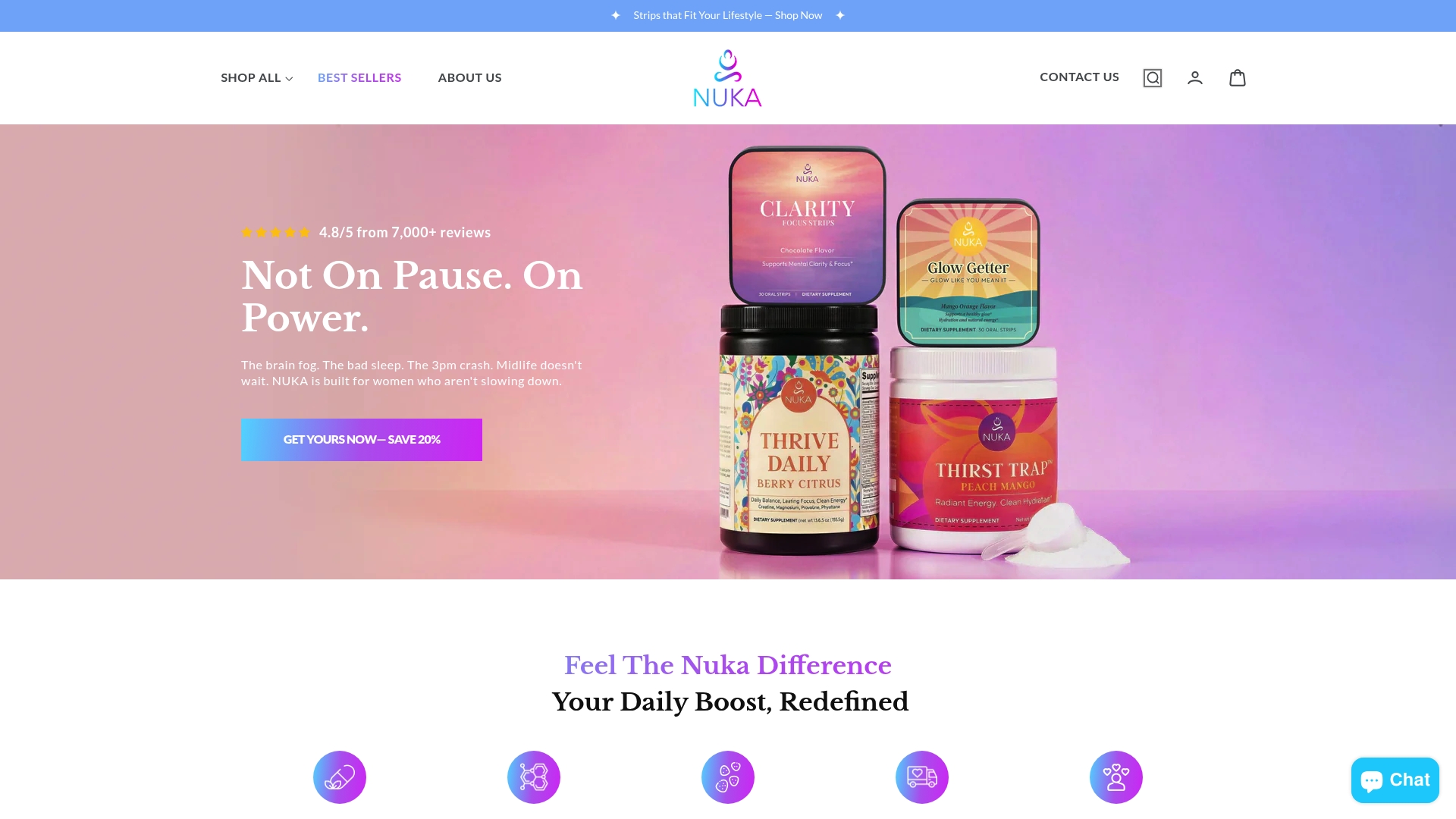
The lineup covers the moments that actually derail a routine. Energy Strips handle the afternoon crash without a sugar-loaded drink. Focus Strips target mental clarity during a long workday. Oral Sleep Strips dissolve fast enough to work with a wind-down routine instead of fighting it, and Hydration Powder mixes into any water bottle in seconds for electrolyte and B-vitamin replenishment. Some products ship in compact, travel-ready formats, and subscriptions may be available for automatic restocks instead of remembering to reorder. Browse the full oral strips collection and pick the format that matches what your week actually needs.
This article is general information, not a substitute for advice from a qualified doctor. Consult a qualified healthcare professional about your own circumstances before acting on anything here.
Sources
- Sublingual and buccal administration and oral thin films (PMC7957312)
- Vitamin D—Health Professional Fact Sheet (NIH ODS)
- The dawning era of oral thin films for nutraceutical delivery (Europe PMC, 2024)
FAQ
What Is the Best Supplement Form for Fast Absorption?
Sublingual oral thin films and micellar liquids absorb fastest because they either bypass digestion through mucosal tissue or arrive pre-dissolved for the gut. OTFs specifically bypass first pass liver metabolism, which lets more of the active nutrient reach your bloodstream.
What Is the Fastest Way to Absorb Vitamins?
Pair the vitamin with its correct timing and meal condition: fat-soluble vitamins (A, D, E, K) with a fat-containing meal, and most water-soluble vitamins on an empty stomach. Choosing a sublingual or oral thin film format for the vitamin in question adds a further speed advantage by skipping standard digestion.
What Is the Best Supplement for Immediate Energy?
Fast-dissolving formats with caffeine or B vitamins tend to act quickest since they avoid the delay of capsule breakdown. Nukalove’s Energy Strips dissolve directly in the mouth for that reason, without needing water or a wait for digestion.
How Do You Fix Poor Vitamin Absorption?
Start by reviewing gut health factors like chronic antacid use, celiac disease, or low stomach acid with a clinician, since these blunt absorption regardless of supplement form. Pairing nutrients correctly (vitamin C with iron, fat with fat-soluble vitamins) and choosing chelated mineral forms or oral thin films can meaningfully improve uptake once underlying issues are addressed.