

Do Energy Strips Actually Work? The Real Benefits Explained
Yes, energy strips deliver real, short-term benefits: sharper mental focus, a fast alertness boost, and a smoother energy curve than sugar-loaded drinks, provided you use them at a sensible dose. Most strips combine caffeine, L-theanine, and B vitamins, typically containing a moderate dose of caffeine per strip, comparable to the caffeine found in a half cup to a full cup of coffee. That dose is where most of the benefit lives:
- Improved focus and reaction time from caffeine paired with L-theanine
- Fewer jittery crashes than a 200 mg energy drink delivers in one hit
- A dissolvable format you can use anywhere, without water or a mug
One caveat matters more than any marketing claim: track your total daily caffeine across coffee, tea, and strips, and check with a doctor first if you’re pregnant, breastfeeding, or managing a heart condition.
Key Takeaways
Energy strips deliver real short-term focus and alertness benefits at moderate caffeine doses, but their biggest edge over coffee or pills is portability and precise dosing, not raw speed.
| Point | Details |
|---|---|
| Verdict on effectiveness | Strips provide real short-term focus and alertness benefits at typical 50–80 mg caffeine doses per strip. |
| Top benefit: calmer focus | Caffeine paired with L-theanine improves attention while reducing the jitteriness caffeine alone can cause. |
| Speed claims are overstated | Strips absorb only marginally faster than coffee; convenience and dosing control are the real advantage. |
| Top safety rule | Track total daily caffeine across all sources and stay within moderate adult intake guidance. |
| Next step with NUKA | Try GO GIRL energy strips for a measured, travel-ready dose paired with L-theanine. |
This article is general information, not a substitute for advice from a qualified doctor. Consult a qualified healthcare professional about your own circumstances before acting on anything here.
Table of Contents
- How Do Energy Strips Deliver Their Energy Boost?
- What Benefits Do People Actually Notice From Energy Strips?
- What’s In Energy Strips, and Does the Research Hold Up?
- How Much Caffeine Is Safe, and What Should You Watch For?
- Who Benefits Most From Energy Strips, and Who Should Be Cautious?
- How Should You Actually Use an Energy Strip?
- Why NUKA Builds Strips Around Precision, Not Hype
- How NUKA’s Strips Put These Benefits Into Practice
- Sources
How Do Energy Strips Deliver Their Energy Boost?
An energy strip dissolves on your tongue in under a minute, and some of the active ingredients get absorbed straight through the oral mucosa, the thin tissue lining your mouth. The rest gets swallowed with your saliva and absorbed the conventional way, through your gut. This split-route delivery is part of why strips feel like they hit fast, but formulation, how much you’re salivating, and how quickly you swallow all affect how much actually gets absorbed sublingually rather than through digestion.
Here’s where the marketing gets ahead of the science. Expert commentary on caffeine delivery notes that strips may be marginally faster than pills but aren’t dramatically faster than coffee, which tempers the “instant energy” framing you’ll see on some product pages. Separate research on other oral-caffeine formats backs this up: studies comparing caffeine gum against tablets found gum sometimes delivered less total absorbed caffeine, not more, showing that oral-format absorption isn’t automatically superior just because it skips the stomach.
The real advantage of a strip isn’t raw speed. It’s that you know exactly what dose you’re taking, and you can take it anywhere without brewing anything or opening a can.
That distinction changes how you should think about strips:
- If you need speed above all else, a strip and a cup of coffee will land in a similar window.
- If you need portability, discretion, and a fixed, repeatable dose, the strip format wins clearly.
- If you’re combining a strip with a swallowed pill or drink for a bigger hit, you’re likely just adding caffeine faster than your body clears it, not multiplying the effect.
The practical takeaway: strips earn their place in your bag not because they’re a caffeine hack, but because they remove the guesswork. You know the milligrams, you know the timing, and you don’t need a kitchen to use one.
What Benefits Do People Actually Notice From Energy Strips?
The benefits people report from energy strips cluster around four areas, and they’re consistent with what caffeine and L-theanine research actually shows, not just what packaging promises.
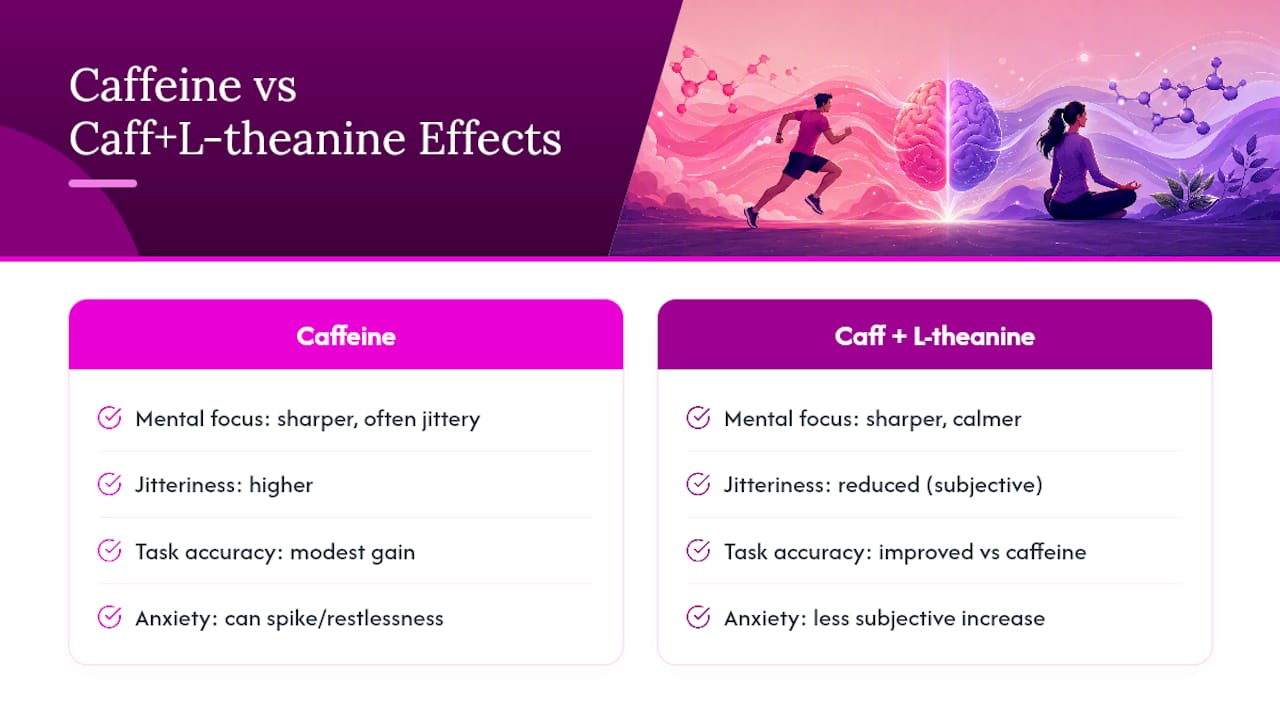
1. Mental focus that feels calmer, not jittery. Caffeine alone can sharpen attention but also spike anxiety and restlessness in sensitive people. Pairing it with L-theanine changes that profile. Clinical trials on the combination found improved task accuracy and reduced subjective jitteriness compared with caffeine on its own, which is exactly why most strip formulas include both rather than caffeine alone.
2. Reduced mid-afternoon slump. The 2 p.m. crash usually comes from a blood sugar dip, often made worse by a sugary energy drink that spikes and drops fast. A strip with no sugar and a moderate caffeine dose avoids that second crash. Research on caffeine’s cognitive effects supports modest but real improvements in alertness and reduced mental fatigue at moderate intake, which lines up with why a strip after lunch tends to smooth out the afternoon rather than spike and dump you.
3. A limited but real endurance edge, with realistic expectations. If you take a strip 20 to 30 minutes before a workout, you may notice a small boost in perceived effort and stamina. But the performance research on caffeine and exercise mostly used higher, controlled doses than what one strip provides. Reviews on caffeine and athletic performance found mixed results for low-dose oral formats specifically, so don’t expect a single 60 mg strip to replicate what a measured pre-workout dose does in a lab study.
4. Portability that actually changes behavior. This is the benefit that’s easiest to underrate. A strip fits in a wallet, a laptop sleeve, or a coat pocket. It survives airport security, a gym bag, and a work bag without spilling or needing refrigeration. For a lot of people, that convenience is the reason they use one consistently instead of skipping their usual energy routine when they’re away from a kitchen.

Pro Tip: If you’re using a strip before a workout, take it around 20 minutes beforehand on an empty-ish stomach. Absorption through the oral tissue starts fast, but digestion of the swallowed portion needs a head start too.
What’s In Energy Strips, and Does the Research Hold Up?
Most energy strips build around three core actives, and each one has a different evidence profile worth knowing before you judge the benefit claims.
Caffeine is the primary driver. At the 50 to 80 mg range typical of a single strip, you’re getting roughly the effect of a half cup of drip coffee. That’s enough for the alertness and fatigue-reduction benefits documented in caffeine research, without pushing into the range where jitteriness or a crash becomes likely for most healthy adults.
L-theanine, usually dosed around 30 mg to pair with the caffeine, is the ingredient doing the quiet work. It’s an amino acid found naturally in tea, and when combined with caffeine, it reduces the jittery, anxious edge that caffeine alone can cause in some people, while preserving or improving task accuracy. This is the single strongest evidence-backed reason strip formulas differ from a plain caffeine pill.
Vitamin B12 shows up in almost every energy strip on the market, but its evidence is the most overstated of the three. The NIH Office of Dietary Supplements is clear that B12 supports normal energy metabolism at the cellular level, but supplementation only produces a noticeable energy lift in people who are actually deficient. If your B12 status is normal, extra B12 in a strip isn’t doing much beyond covering your baseline needs.
The ingredient list, in short:
- Caffeine (often from green tea extract): the main active, 50 to 80 mg per strip
- L-theanine (roughly 30 mg): smooths caffeine’s edge, backed by controlled trials
- B-complex vitamins, especially B12: supports metabolism generally, limited acute effect if you’re not deficient
The takeaway on evidence strength: caffeine and L-theanine have real trial data behind the combination. B12’s role is legitimate but overstated on packaging that implies an instant energy jolt.
How Much Caffeine Is Safe, and What Should You Watch For?
Energy strips are safe for most healthy adults at typical doses, but the safety conversation is about your total daily intake, not any single strip.
- Know your daily ceiling. Guidance summarized in caffeine-safety reporting puts moderate daily intake around 200 to 400 mg for healthy adults, with pregnancy limits set considerably lower. A single 60 mg strip is a small fraction of that, but two strips plus a coffee plus an afternoon soda adds up fast.
- Watch for stacking. The most common mistake is combining a strip with coffee or an energy drink without doing the math. Symptoms of overuse include a racing heart, jitteriness, trouble sleeping, and stomach upset. If you notice these, you’ve likely stacked past your comfortable threshold.
- Flag special circumstances before you start. Pregnant or breastfeeding people should keep total caffeine intake well under the general adult range. Anyone managing arrhythmias, heart conditions, or taking medications that interact with stimulants should talk to a provider before adding a caffeine strip to their routine.
- Track sources for a week. Jot down every caffeine source you use, coffee, tea, strips, chocolate, medications, for a few days. Most people are surprised how much they’re already consuming before a strip enters the picture.
The single most useful habit here is simple: treat a strip as one caffeine source among several, not a bonus outside your normal intake.
Who Benefits Most From Energy Strips, and Who Should Be Cautious?
Energy strips fit best into lives that move, not lives that sit still near a coffee machine all day.
- Frequent travelers and commuters who need a reliable, TSA-friendly option without hunting for a coffee shop.
- Shift workers managing irregular schedules who need a discreet, precisely dosed option between shifts.
- People in meetings or open offices who want a boost without brewing anything or explaining a can of energy drink.
- Women navigating perimenopause and menopause, where fatigue and brain fog can hit unpredictably and a measured, low-dose option beats guessing with a double espresso.
Caution applies to anyone pregnant or breastfeeding, anyone with a diagnosed arrhythmia or other stimulant-sensitive heart condition, and anyone already at their daily caffeine ceiling from other sources. For that last group, a caffeine-free strip built around adaptogens or B vitamins alone is often the better starting point, and it’s worth exploring caffeine-free energy options if stimulants aren’t a fit for your body right now.
How Should You Actually Use an Energy Strip?
Getting the benefit without the overuse risk comes down to timing and a little planning.
- For focus tasks: take a strip 15 to 20 minutes before you need peak attention, a presentation, a long drive, a deadline sprint.
- For workouts: take it 20 to 30 minutes pre-exercise, and skip your usual coffee that morning if you’re stacking otherwise.
- Space your doses: wait at least four to six hours between strips if you’re using more than one in a day, and count any coffee or tea in that window.
- Store them right: keep the packet sealed and away from heat and humidity, glove compartments and gym bags in summer are the two worst offenders.
Pro Tip: Keep a note on your phone logging when you take a strip and how you feel an hour later. After a week, you’ll know your real effective dose instead of guessing.
For travel-specific routines, including how to plan strip use around time zones and flight schedules, the menopause travel guide covers the logistics in more detail.
Why NUKA Builds Strips Around Precision, Not Hype
We built our strip formulas around one question: what does a woman navigating hormonal shifts actually need mid-afternoon, not what sounds impressive on packaging. That meant fixed, measured caffeine doses paired with L-theanine rather than a vague “energy blend,” and it meant offering caffeine-free options for anyone managing sleep sensitivity or symptom flare-ups during menopause. Every strip is designed to survive a suitcase, a purse, or a desk drawer without special storage.
We’d rather you take one strip and know exactly what you got than take three products and guess.
— NUKA
How NUKA’s Strips Put These Benefits Into Practice
Everything covered above, measured caffeine, the L-theanine pairing, no added sugar, portable format, is exactly what our GO GIRL energy strips were built to deliver. Each strip carries a consistent, moderate caffeine dose paired with L-theanine, so you get the focus benefit without the jittery overshoot, and no water or mixing required.
If skin and hair support are also on your radar, the GLOW GETTER strips use the same fast-dissolving format for a different daily need, and both are available as single tins or travel packs so you can test one before committing to a subscription. For a full comparison of strip options built specifically around midlife energy needs, our guide to the best energy strips for menopause breaks down dosing and formulation differences side by side.
Ready to try one? Order a single tin or a travel pack from the NUKA product line and see how a measured dose feels compared to your usual coffee or energy drink.
Sources
- Study: L-theanine and caffeine effects on cognition (PubMed)
- Review: Caffeine and cognitive effects (PubMed)
- NIH Office of Dietary Supplements — Vitamin B12 fact sheet
- Caffeine strips: risks and rewards (The Conversation)