

Vitamin Strips for Travelers: B12, Melatonin, and How to Shop
Yes, dissolvable vitamin strips work for a specific set of nutrients, and no, they don’t replace a full multivitamin. Strips rely on transmucosal absorption, meaning the active dissolves against the lining of your mouth and enters the bloodstream directly instead of trekking through your stomach and liver first. That mechanism gives certain low-dose, potent actives like B12 or melatonin a real edge in speed. But the same mechanism caps how much a strip can hold, so anything requiring hundreds of milligrams (think magnesium or vitamin C) still belongs in a capsule or powder.
TL;DR:
- Vitamin strips are limited to small, potent nutrients like B12 and melatonin due to their low active ingredient capacity.
- Transmucosal absorption bypasses first-pass metabolism, offering faster effects mainly for small, lipid-soluble molecules.
- Evidence supports their benefits for compliance and speed but does not prove they outperform pills for most nutrients or overall health outcomes.
- The format is ideal for travel, sleep support, and correcting deficiencies in specific populations such as older adults or vegans.
- Always verify the active chemical form and packaging type before purchasing, as many products differ in dose, stability, and suitability for your needs.
Table of Contents
- What Vitamin Strips Actually Are
- How Transmucosal Absorption Actually Works
- What the Research Actually Shows
- Weighing the Trade-Offs Before You Switch
- Who Actually Benefits, and When to Call a Doctor
- What NUKA Recommends When You’re Shopping for Strips
- Regulatory Status and Quality Standards
- Side Effects and Allergic Reactions Worth Knowing
- Strips vs. Tablets, Capsules, and Gummies
- Which Nutrients Actually Belong in Strip Form
- What Actually Matters Once You Cut Through the Hype
- Try Nukalove’s Oral Strips for Convenient, Travel-Ready Wellness
- Sources
What Vitamin Strips Actually Are
An oral dissolving film, often sold under the friendlier name “vitamin strip” or “dissolvable strip,” is a thin polymer sheet loaded with an active ingredient that breaks apart on contact with saliva, usually within seconds. The format isn’t a supplement industry invention. Oral dissolving films already have an established track record in the regulated over-the-counter drug market, showing up in motion sickness treatments and pain relievers, which tells you the manufacturing and regulatory groundwork was solid before vitamin brands adopted it.
The film itself is mostly excipient, not active ingredient. Manufacturers build the base from glycerin, sorbitol, and various gums, then add flavoring to mask what would otherwise be a fairly bitter mouthful. That base determines how the strip holds up in a purse, a gym bag, or a suitcase.
A few structural facts matter more than most people realize:
- Most strips carry relatively low active loads, which limits their suitability for minerals like calcium or magnesium that require higher doses.
- The polymer base is moisture-sensitive, which is why quality brands seal each dose in individual foil packaging rather than a shared tin.
- Flavoring and plasticizers affect both shelf stability and mouthfeel, and cheap formulations tend to show it in texture or aftertaste.
- Because the dose is fixed per strip, splitting or adjusting dosage isn’t really an option the way it is with a scored tablet.
That dosing ceiling is the single biggest thing to understand before buying. It’s also exactly why strips work so well for some nutrients and not at all for others.
How Transmucosal Absorption Actually Works
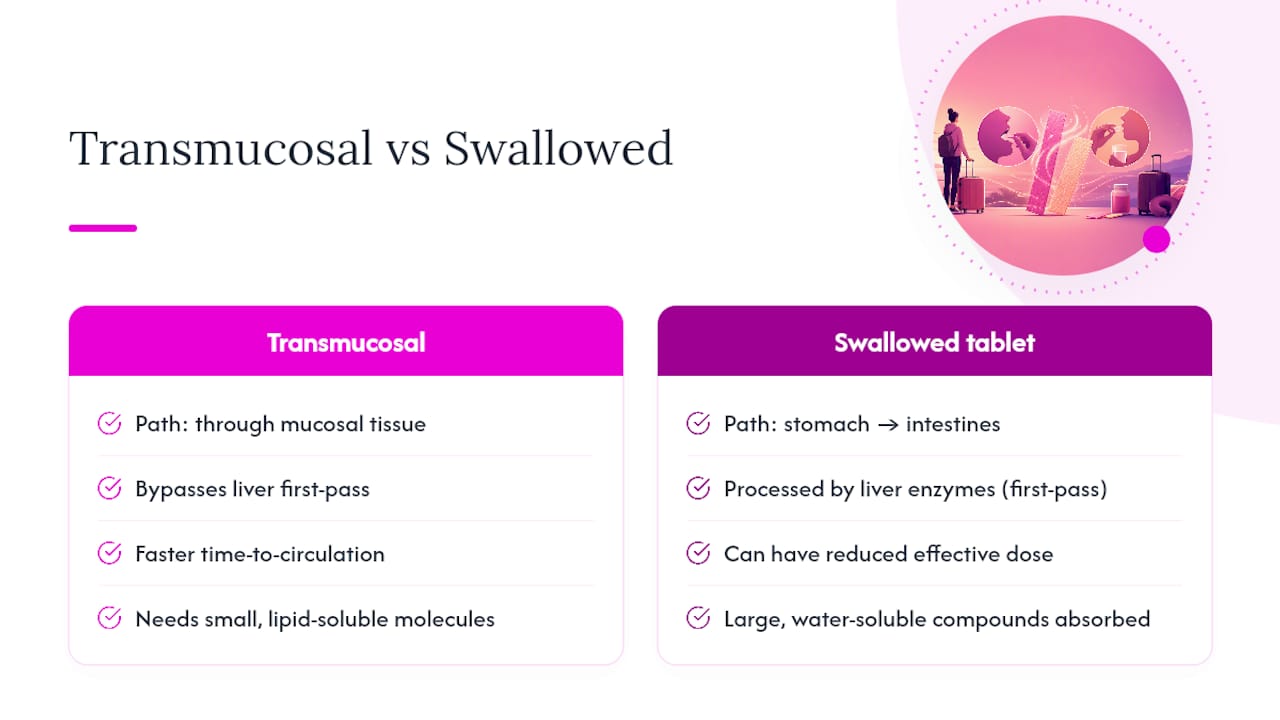
Your mouth is lined with a thin, highly vascular tissue that sits close to blood vessels feeding directly into systemic circulation, bypassing the liver on the way in. Swallow a tablet and the active ingredient survives stomach acid, gets processed by liver enzymes in what’s called first-pass metabolism, and only then reaches your bloodstream. That detour can destroy or drastically reduce the effective dose of some compounds before they ever do anything useful.
A strip that dissolves against the cheek or under the tongue skips most of that route. The active gets absorbed through the mucosal tissue and enters circulation faster, which is why sublingual and buccal delivery show up so often in emergency medicine (nitroglycerin under the tongue for chest pain is the classic example).
The catch is that this route only works for molecules small enough and lipid soluble enough to cross that mucosal barrier efficiently. Large, water soluble compounds mostly get swallowed along with your saliva and processed the regular way anyway, which is part of why a strip’s real advantage depends heavily on which nutrient is inside it.
Pharmacokinetic research on oral thin films backs this up with actual absorption data, not just theory. Reviews of transmucosal drug delivery show measurably faster time-to-circulation for several small-molecule actives compared with standard swallowed tablets. That speed difference is the whole reason a strip can feel like it “hits” faster than a pill. Whether the nutrient inside qualifies for that fast lane depends on its chemistry, not on the strip format itself.
What the Research Actually Shows
The strongest evidence supports strips for compliance and speed, not for blanket superiority over every other supplement format. A widely cited review of orally dissolving strip technology describes rapid dissolution and improved patient adherence as consistent findings, along with the potential to dodge gastrointestinal breakdown for actives that are sensitive to stomach acid.
Sublingual and buccal delivery research adds a more cautious layer. Clinical evidence on sublingual and buccal administration points to real benefit for nutrients with historically poor oral bioavailability, but the same body of research flags a problem: formulations vary wildly between studies, and large, placebo-controlled trials specifically testing wellness-oriented strip products are still thin on the ground.
That gap matters for how you read marketing claims. Here’s where the evidence stands right now:
- Strong, peer-reviewed support exists for the dissolution and compliance benefits of oral film technology broadly.
- Reasonable pharmacokinetic support exists for improved bioavailability of specific small molecules delivered transmucosally.
- Weak or absent support exists for many wellness-outcome claims (energy, mood, “glow”) tied to specific commercial strip products, since those trials are rarely large or independently run.
- Manufacturer-funded studies tend to report bigger bioavailability gains than independent academic reviews, a gap worth noticing before you trust a bold percentage on a product page.
The practical takeaway: strips have genuine science behind the delivery mechanism, and genuine science behind a handful of specific nutrients. They don’t have broad evidence proving they outperform every pill or gummy for every nutrient, and no honest source claims otherwise.
Weighing the Trade-Offs Before You Switch
Every format makes a trade. Strips trade dosage flexibility for speed and convenience, and knowing that trade upfront saves you from disappointment later.
- Fast onset. Because the active skips first-pass metabolism, effects from suitable nutrients (melatonin for sleep, B12 for energy) tend to show up quicker than with a swallowed capsule.
- No water needed. You can take a strip in a car, on a plane, or at your desk without hunting for a water bottle, which matters more than people expect once they try it.
- Better for swallowing difficulties. Anyone who struggles with pills, whether from age, anxiety, or a medical condition, gets a real workaround here.
- Limited dosage capacity. That 10 to 30 milligram ceiling means strips can’t carry the higher-dose minerals and vitamins a daily multivitamin routinely includes.
- Cost per dose runs higher. The manufacturing process and individual foil packaging add expense that a bottle of 100 tablets simply doesn’t carry.
- Stability and taste vary by brand. Cheaper polymer bases can turn gummy or bitter if stored somewhere warm or humid, which is a real complaint in product reviews.
Pro Tip: Check the active ingredient’s chemical form before buying. Methylcobalamin B12 behaves differently in the body than cyanocobalamin, and a strip with a poorly absorbed form of a nutrient loses most of its speed advantage no matter how fast it dissolves.
Who Actually Benefits, and When to Call a Doctor
Strips make the most sense for a fairly specific set of people: older adults with reduced stomach acid affecting B12 absorption, vegans who need a reliable B12 source, frequent travelers who want TSA-friendly single-serve dosing, and anyone with a diagnosed swallowing issue.
They’re a poor primary fit for someone trying to replace a broad-spectrum multivitamin, simply because the format can’t carry enough of most minerals to matter.
Talk to a clinician before relying on strips if you suspect an actual nutrient deficiency rather than a general energy dip, if you take medications with narrow safety margins, or if you’re pregnant or managing a chronic condition. Three questions worth asking directly: Does this nutrient’s chemical form actually cross oral mucosa effectively? Does the strip’s dose meet my specific deficiency target? Could faster absorption change how this interacts with anything else I’m taking?
What NUKA Recommends When You’re Shopping for Strips
Reading a label well matters more than reading a marketing page. Before buying any oral strip, check the active nutrient’s specific chemical form, the per-strip dose in milligrams or micrograms, and whether each dose comes individually sealed rather than loose in a shared container.
- Confirm the active form (methylcobalamin, not just “B12”) and look for the dose printed clearly on the package, not buried in fine print.
- Favor single-serve foil pouches over shared tins, since moisture exposure degrades film strips faster than most people expect.
- Match the strip to an actual use-case rather than a vague wellness goal. Travel days, disrupted sleep schedules, and midlife energy dips are where the format earns its keep.
NUKA builds around exactly those priorities, with resources on sublingual vitamin absorption and on packing supplements for air travel for readers who want the deeper mechanics before they buy.
| What to check | Why it matters |
|---|---|
| Active chemical form | Determines actual absorption, not just speed |
| Per-strip dose | Confirms whether it meets your target intake |
| Packaging type | Single-seal foil protects against moisture damage |
| Use-case fit | Strips shine for travel, sleep, and energy, not full multivitamin replacement |
Regulatory Status and Quality Standards
Vitamin strips sold in the United States fall under dietary supplement rules, not drug regulations, which means they don’t require pre-market approval the way an over-the-counter medication strip does. That distinction surprises a lot of shoppers, since the format looks identical to drug delivery films used for motion sickness or pain relief.
Manufacturers are still responsible for accurate labeling, ingredient safety, and following current good manufacturing practices for supplement production. Quality control mostly comes down to the manufacturer’s own testing rigor: third-party lab verification of active content, contamination screening, and batch consistency testing aren’t legally mandatory for every product, but reputable brands run them anyway because dissolvable formats are more sensitive to degradation than a shelf-stable tablet.
Because the oral film category was pioneered in regulated drug applications, the manufacturing science is mature even where the supplement-specific oversight is lighter. That’s a meaningful reassurance about the format itself, though it’s not a substitute for checking whether a specific brand publishes third-party testing results.
Side Effects and Allergic Reactions Worth Knowing
Most reported issues with vitamin strips are mild and localized rather than systemic. Mouth irritation or a burning sensation shows up in some product reviews, usually tied to specific flavoring agents or the plasticizers used to keep the film flexible.
Taste aversion is common enough to be worth mentioning outright. Bitter actives like B12 or certain B-complex nutrients need heavier flavor masking, and cheaper formulations sometimes leave an unpleasant aftertaste that lingers longer than a swallowed capsule ever would.
Allergic reactions tend to trace back to specific excipients rather than the vitamin itself, so anyone with known sensitivities to particular gums, sugar alcohols, or artificial flavoring should read the ingredient list as carefully as they’d read a food label. If you notice swelling, persistent mouth sores, or any reaction beyond mild tingling, stop use and check with a healthcare provider before trying another strip product, even from a different brand.
Strips vs. Tablets, Capsules, and Gummies
No single format wins across the board, and the honest comparison depends on what you’re optimizing for. Tablets and capsules still carry the dosage flexibility crown, since they can hold hundreds of milligrams of a mineral that a strip physically cannot fit. Gummies offer palatability but often add sugar and still route through the same first-pass metabolism as any swallowed pill.
Strips win decisively on convenience and onset speed for the nutrients they’re actually suited to. No water, no chewing, and for compounds like B12 or melatonin, a faster path into circulation. User preference data from product reviews consistently mentions portability and ease of dosing as the top reasons people switch, not superior nutrient content.
The realistic verdict: strips aren’t a strict upgrade over tablets or capsules, they’re a different tool suited to different situations. Someone managing a diagnosed mineral deficiency probably still needs a capsule that can carry a real dose. Someone who wants fast, portable energy or sleep support without swallowing anything is exactly who the format was built for.
Which Nutrients Actually Belong in Strip Form
Not every vitamin translates well to a dissolving film, and knowing which ones do saves you from buying based on marketing alone.
Vitamin B12 is the standout example, particularly in its methylcobalamin form, since it’s a small molecule with well-documented absorption benefits through sublingual delivery, especially for people with reduced stomach acid or absorption issues. Melatonin is another strong fit, given its low effective dose and the value of fast onset for sleep timing. Vitamin D, in smaller doses, and certain B-complex vitamins also show up reasonably often in strip form because their effective doses stay within that 10 to 30 milligram ceiling.
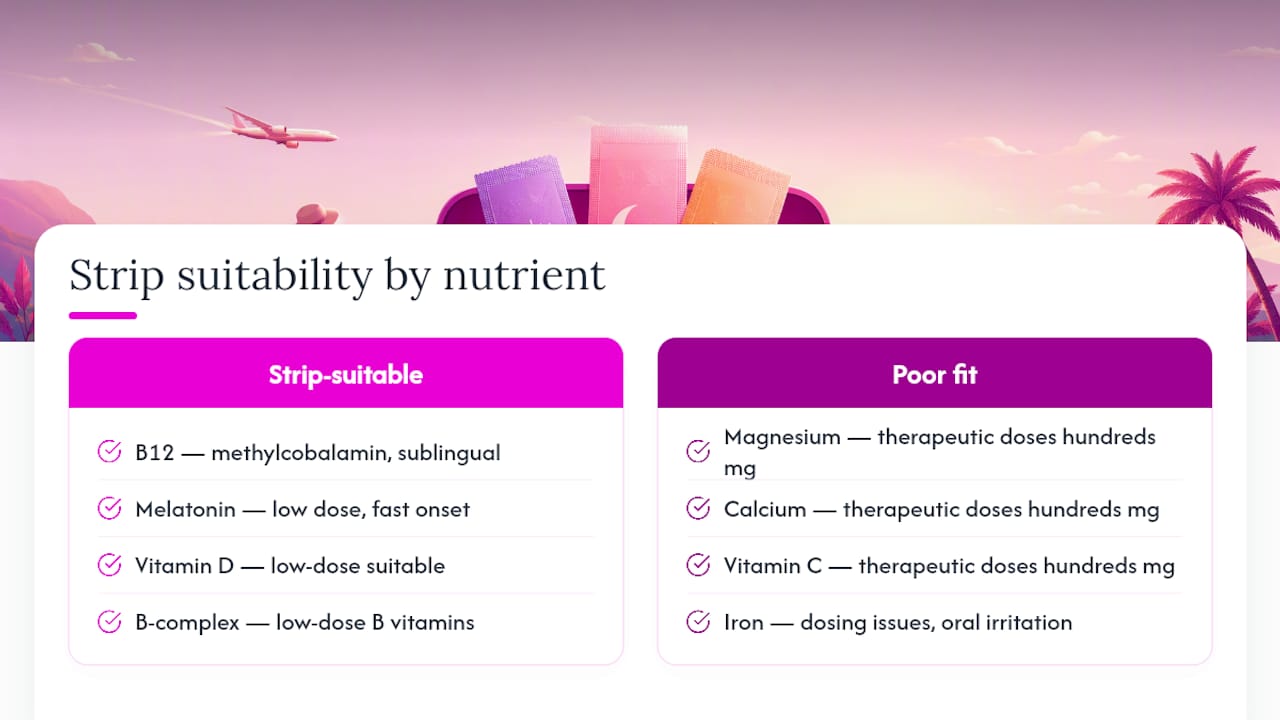
What doesn’t work: magnesium, calcium, and vitamin C in any meaningful dose, since therapeutic amounts of these run into the hundreds of milligrams, far past what a thin film can physically carry. Iron is a poor candidate too, both for dosing reasons and because it can be harsh on oral tissue in concentrated form.
What Actually Matters Once You Cut Through the Hype
The conventional pitch around vitamin strips oversells them as a universal upgrade, and that’s the part worth pushing back on. Strips aren’t better absorbed across the board. They’re better absorbed for a specific, narrow list of small-molecule nutrients, and unremarkable or irrelevant for everything else a typical multivitamin covers.
Where the research holds up, it holds up well: transmucosal delivery genuinely bypasses first-pass metabolism, and for something like B12 or melatonin, that translates to a real practical difference in how fast you feel an effect. Where it falls apart is in the assumption that “dissolves faster” equals “works better” for every nutrient on a label. It doesn’t, and dosage ceilings alone rule out a huge share of what a full multivitamin needs to deliver.
The smartest way to use strips isn’t as a wholesale replacement. It’s as a targeted tool for the handful of nutrients and situations where the format’s biology actually gives you something a pill can’t.
— NUKA
Try Nukalove’s Oral Strips for Convenient, Travel-Ready Wellness
This product line focuses on nutrients that benefit from fast, transmucosal delivery, packaged for convenience and ease of use, especially for those who prefer not to manage pills while traveling or with a busy schedule. Each strip is single-sealed to protect against moisture sensitivity that can degrade the product, and dosed with active forms intended to cross oral mucosa effectively.
If sleep timing is your specific issue, the Deep Zzzs oral sleep strips target exactly the melatonin use-case where strip delivery has real backing. For skin and hair support, the Glow Getter oral strips apply the same fast-absorption approach to a different nutrient set. Browse the full wellness strip collection to find the formula that matches what you actually need, and check out one strip today to feel the difference for yourself.
Sources
- Review: Oral thin films and transmucosal delivery (PMC7957312)
- Clinical evidence and pharmacokinetics of sublingual/buccal delivery (PMC6566230)