

Crepey Skin Menopause Remedies That Actually Work
The combination that reliably improves crepey skin after menopause is daily broad-spectrum SPF 30+, moisturizer applied to damp skin, and a collagen-supporting active like a retinoid or peptide serum, worn in consistently for at least six to eight weeks. Lifestyle habits (protein intake, sleep, resistance training, no smoking) support the process from the inside. For skin with significant laxity, in-office treatments like biostimulators or hyaluronic acid boosters can do what topicals alone cannot.
None of that is complicated. What trips most women up is expecting a single product to do the whole job, or giving up on a good routine after ten days because nothing “happened.”
Start with these three things today:
- Apply SPF 30+ every single morning, even on cloudy days, even if you’re indoors most of the day near a window.
- Moisturize while your skin is still damp from washing, not after it’s dried out. This traps water instead of chasing it.
- Introduce one active ingredient at a time — a retinol or a peptide serum, not both at once, and not at full strength on day one.
Hydration shows up relatively quickly. Firmness takes longer to improve.
Pro Tip: Take a well-lit, makeup-free photo of your neck and hands today, in the same spot and same light you’ll use for follow-up shots. Six weeks from now, this is the only way you’ll actually see the change instead of doubting your memory.
Clinical guidance from the Cleveland Clinic recommends giving over-the-counter actives eight to twelve weeks before deciding they aren’t working. If you’ve done that and see nothing, that’s your cue to book a dermatologist visit rather than switch products again.
| Point | Details |
|---|---|
| First move | Apply SPF 30+ daily and moisturize damp skin morning and night. |
| Add one active | Introduce a retinol or peptide serum slowly, a few nights per week to start. |
| Set a timeline | Give any new routine 8 to 12 weeks before judging results. |
| Escalate if needed | See a dermatologist if there’s no change after 8 to 12 weeks of consistent care. |
Key Takeaways
Consistent daily sun protection, damp-skin moisturizing, and a collagen-supporting active are the foundation of every effective crepey skin remedy after menopause.
| Point | Details |
|---|---|
| Sunscreen first | Apply SPF 30+ every morning; it’s the single biggest preventable factor. |
| Moisturize damp skin | Apply moisturizer right after washing to trap water for immediate plumping. |
| Add actives slowly | Introduce one retinoid or peptide product at a time, a few nights per week. |
| Give it time | Expect several weeks for visible texture and firmness changes. |
| Consider Nukalove Glow Getter | Use these oral strips as a portable, inside-out adjunct alongside topical care. |
Pro Tip: If body-image frustration around crepey skin is affecting your mood or confidence, that’s worth talking through with a therapist or trusted doctor, not just a skincare routine. Skin is one part of a much bigger transition.
Table of Contents
- Why Crepey Skin Gets Worse During Menopause
- A Simple Daily Routine to Reduce Crepey Texture
- Which Active Ingredients Actually Help, and How to Use Them
- Diet, Habits, and Supplements: What Helps and What’s Overhyped
- In-Office Treatments for More Significant Crepey Skin
- Does Hormone Therapy Help Crepey Skin?
- How Long Until You See Results?
- When to See a Dermatologist
- What the Research Actually Supports
- A Practical Perspective on Getting Started
- A Simple Adjunct Worth Adding to Your Routine
- Frequently Asked Questions
- Sources
Why Crepey Skin Gets Worse During Menopause
Estrogen does more for your skin than most women realize until it drops. It helps regulate collagen production, elastin, ceramides, and the oil glands that keep skin supple. When estrogen declines during perimenopause and menopause, all four of those systems lose ground at once, and the skin barrier starts losing water faster than it can replace it.
That’s the internal half of the story. The external half is decades of sun exposure that quietly broke down collagen and elastin fibers long before menopause started. According to a Providence health report, UV exposure is the single biggest external driver of the collagen and elastin breakdown that produces crepey texture. Menopause doesn’t cause that damage. It removes the hormonal support that used to help mask it.
Estrogen loss during menopause leads to measurable reductions in collagen and skin barrier function, and consistent skin care over multiple weeks is typically needed before visible improvement appears, according to the American Academy of Dermatology.
Here’s the cause-and-effect chain in plain terms:
- Estrogen drops → collagen and elastin production slows over time.
- Oil gland output shrinks → skin gets drier, barrier weakens.
- Barrier weakens → water escapes faster (transepidermal water loss).
- Thinner, drier skin with less structural support → the crepe-paper look on the neck, chest, upper arms, and backs of the hands.
Crepey skin rarely shows up alone. Research on menopause-associated skin changes published in the Journal of Integrative Dermatology notes that estrogen loss affects pigmentation, sensitivity, and hair alongside texture changes, so it helps to think of crepey skin as one symptom of a broader shift rather than an isolated problem. If you want more background on how these hormonal shifts show up beyond the skin, this rundown of perimenopause symptoms covers the full picture.
A Simple Daily Routine to Reduce Crepey Texture
You don’t need a ten-step routine. You need the right four steps done consistently, in the right order, at the right time of day.
- Cleanse gently. Use a cream or gel cleanser, not a foaming one that strips oil. Skip long, hot showers, which pull moisture out of already-dry skin.
- Treat while skin is slightly damp. This is when serums with retinoids, peptides, or hyaluronic acid absorb best and when moisturizer traps the most water.
- Hydrate with a richer moisturizer or body cream. For body skin especially, go heavier than you think you need to.
- Protect with SPF 30+ every morning, and consider a lightweight hat or UPF clothing on the days you’re outside longer than a quick errand.
At night, swap step 4 for a second layer of moisturizer or a facial oil if your skin runs dry. If you’re new to retinoids, start two to three nights a week, not nightly. Your skin needs time to adjust.
What to skip: harsh physical scrubs, daily hot baths, and layering three new active ingredients in the same week. Your barrier is already compromised. Give it less to fight, not more.
Pro Tip: If a retinoid leaves your skin tight or flaky at first, apply your moisturizer first, then the retinoid over it. This “buffering” trick slows absorption slightly and cuts irritation without canceling the benefit.
Which Active Ingredients Actually Help, and How to Use Them
Not every ingredient on a skincare shelf deserves your money. These do, based on the evidence, and each one works differently.
| Ingredient | What it does | How to use it | Watch for |
|---|---|---|---|
| Retinoids (retinol, tretinoin/Retin-A) | Boosts cell turnover and stimulates collagen production | Start 2 to 3 nights/week, low concentration; prescription tretinoin for faster results | Dryness, peeling, sun sensitivity, increases photosensitivity |
| Peptides | Signal skin to produce more collagen | Layer under moisturizer, morning or night | Generally well tolerated, results are gradual |
| Hyaluronic acid (HA) | Draws water into the skin, plumps immediately | Apply to damp skin, seal with moisturizer | Can dehydrate skin if used in very dry climates without sealing |
| Alpha hydroxy acids (glycolic, lactic acid) | Exfoliate surface cells, improve texture and tone | 2 to 3 times weekly for face; can use more often on body | Sun sensitivity, irritation if overused |
| Antioxidants (vitamin C, vitamin E, niacinamide) | Protect against UV and pollution damage, support barrier repair | Vitamin C in the morning under sunscreen; niacinamide morning or night | Mild tingling with high-concentration vitamin C |
| Broad-spectrum sunscreen SPF 30+ | Prevents further collagen and elastin breakdown | Every morning, reapply if outdoors for hours | Reapplication is the most commonly skipped step |
Clinical evidence backs up the core players here. A review of topical retinoids and antioxidants found partial reversal of photodamage with retinoid use, plus measurable improvements in hydration and elasticity from topical antioxidants.
The safest way to start retinoids: begin with over-the-counter retinol at a low percentage, twice a week, and only move toward prescription tretinoin once your skin tolerates that without irritation. That transition can take a few months, not a few weeks.
For layering multiple actives safely:
- Vitamin C in the morning, always under sunscreen.
- Retinoid at night, never in the same routine as AHAs on the same evening.
- HA can go under almost anything, applied to damp skin first.
- If you want AHAs on your body but a retinoid on your face, that’s a fine way to split the workload without overloading one area.
Diet, Habits, and Supplements: What Helps and What’s Overhyped
Your skin is downstream of everything else your body is doing, which means lifestyle factors matter more than most skincare marketing admits, and less than supplement marketing claims.
What actually moves the needle:
- Adequate dietary protein gives your body the raw material for collagen synthesis.
- Resistance training improves the muscle tone underneath skin, which changes how the skin above it looks and drapes.
- Consistent sleep supports the repair processes that happen overnight.
- Quitting smoking stops one of the fastest routes to collagen breakdown there is.
What’s overstated:
- Topical collagen creams. Collagen molecules are too large to penetrate the skin barrier, so a jar of “collagen cream” is mostly marketing.
- Oral collagen as a cure-all. Collagen peptides get broken down during digestion, though some studies on collagen peptide supplements show modest benefits for skin hydration and elasticity.
- Any supplement promising visible results in days. Skin remodeling takes weeks at minimum.
The Cleveland Clinic is direct about this: diet and lifestyle changes support skin repair, but they complement topical and procedural treatments rather than replace them. If collagen supplementation interests you, this explainer on collagen and menopause breaks down what the research actually supports versus what’s marketing noise.
A few caveats worth taking seriously: collagen peptides can interact with certain medications in rare cases, and high-dose supplements aren’t automatically safe just because they’re sold over the counter. If you’re on prescription medication or managing another health condition, check with your doctor before adding a new supplement regimen, particularly one you plan to take daily for months.
In-Office Treatments for More Significant Crepey Skin
Home care has real limits. When skin laxity is advanced, or when decades of sun damage have thinned the dermis significantly, topicals alone often only partially address the problem. That’s when dermatologists and plastic surgeons bring in procedural options.
- Microneedling creates controlled micro-injuries that trigger the body’s own collagen repair response, with minimal downtime and multiple sessions typically needed.
- Radiofrequency (RF) treatments heat the deeper skin layers to tighten existing collagen, often with little to no downtime.
- Laser resurfacing addresses both texture and pigmentation, with recovery time ranging from a few days to two weeks depending on intensity.
- Ultrasound therapy targets deeper tissue laxity, commonly used on the face and neck.
- Dermal fillers restore lost volume, which can visually soften crepey texture by filling the space underneath it.
- Biostimulators like poly-L-lactic acid (PLLA/Sculptra® Aesthetic) stimulate the body’s own collagen production over time rather than adding immediate volume.
A controlled study currently evaluating combinations of small-particle hyaluronic acid boosters (Restylane Skinboosters) and PLLA in postmenopausal adults is looking specifically at hydration and laxity outcomes in this population, though the trial registration notes it’s still gathering data and sample sizes in this space tend to be modest.
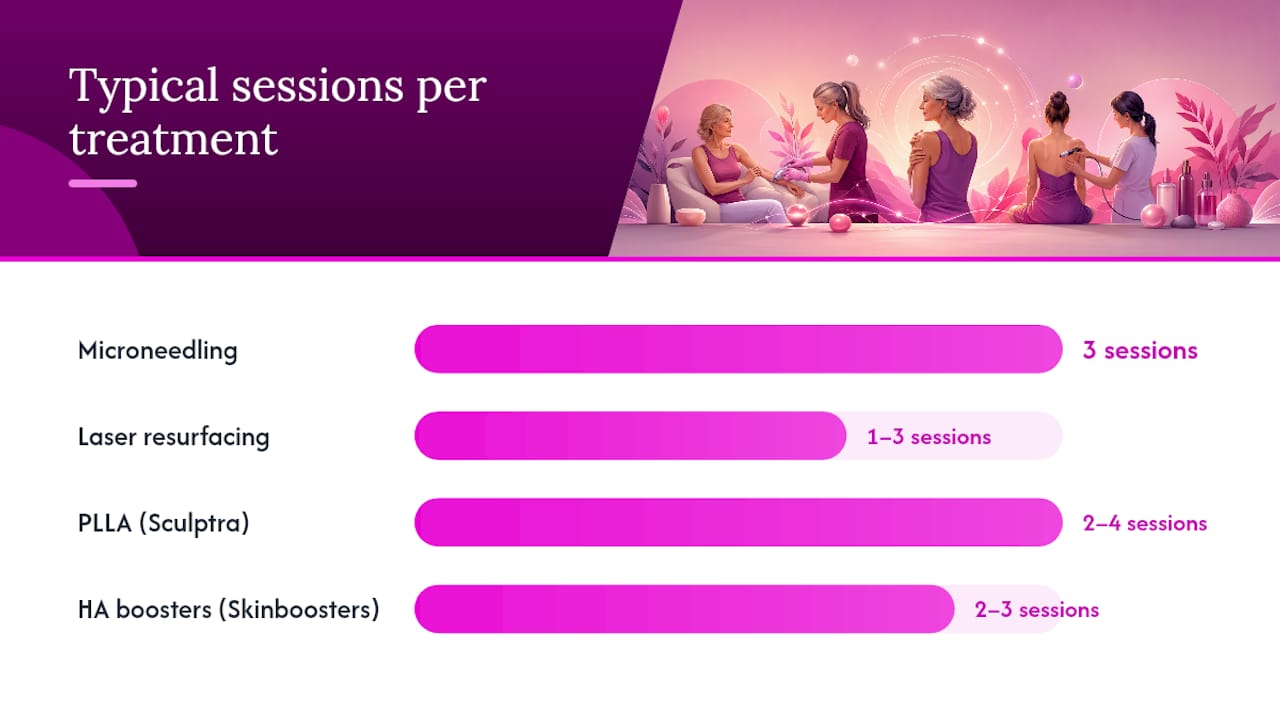
| Treatment | Primary target | Typical sessions | Downtime |
|---|---|---|---|
| Microneedling | Texture, mild laxity | 3 sessions | 1 to 3 days |
| Radiofrequency | Skin tightening | Multiple, spaced weeks apart | Minimal to none |
| Laser resurfacing | Texture and pigmentation | 1 to 3 sessions | 3 days |
| PLLA (Sculptra) | Collagen stimulation, volume | 2 to 4 sessions over months | Mild swelling, days |
| HA boosters (Skinboosters) | Hydration, fine crepiness | 2 to 3 sessions | Minimal |
Home care is appropriate as a first step for almost everyone. Consider an in-office consultation once you’ve given topicals a genuine eight to twelve week trial without meaningful change, or if skin laxity is affecting how clothing fits or how you feel getting dressed each day.
| Point | Details |
|---|---|
| Try topicals first | Give retinoids, AHAs, and antioxidants sufficient weeks before considering procedures. |
| Procedures address laxity | Microneedling, RF, and lasers target texture; fillers and PLLA address volume loss. |
| Sessions add up | Most procedures require multiple visits spaced weeks apart, not a single treatment. |
Does Hormone Therapy Help Crepey Skin?
Hormone replacement therapy sits in a gray zone that’s worth understanding clearly before you factor it into a skin plan. Systemic HRT can improve overall skin quality for some women, but evidence for reversing already-established crepey skin remains limited.
Systemic hormone therapy may help skin quality for some patients, but clinical data supporting reversal of established crepey skin remains limited, and topical estrogen is not an FDA-approved standard treatment for general skin rejuvenation, according to a clinical review of hormone therapy and skin.
Vaginal estrogen is a different situation entirely and is well supported for treating local vaginal dryness during menopause. That’s a targeted, evidence-backed use case. It’s not the same thing as using estrogen creams on your neck or arms to fix crepiness there, which isn’t a standard or approved approach.
The decision to start systemic HRT involves weighing broader risks and benefits with a clinician, not choosing it as a skin treatment on its own. If skin improvement happens alongside HRT taken for other menopause symptoms, treat that as a welcome side effect rather than the reason to start. For women exploring options outside hormone therapy, these non-hormonal relief alternatives cover approaches worth discussing with a doctor.
How Long Until You See Results?
Patience is the hardest part of any skin routine, mostly because different changes happen on wildly different timelines.
Take your progress photos in the same spot, same lighting, same time of day if you want an honest read on change. Memory alone tends to either overstate or completely miss gradual improvement.
Be realistic about limits. Decades of accumulated sun damage or the loose skin that follows significant weight loss generally won’t respond to topical care alone, no matter how disciplined the routine. Those situations usually call for procedural intervention from the start, not months of serums first.
When to See a Dermatologist
Most crepey skin responds, at least partially, to consistent home care. A few situations call for a professional opinion sooner rather than later.
- Crepiness that appeared suddenly rather than gradually over months or years.
- Texture that’s worsening rapidly, not just staying the same.
- Skin changes you suspect are linked to a new medication.
- Laxity severe enough to affect how clothing fits or cause physical discomfort.
- No improvement after 8 to 12 weeks of a genuinely consistent topical routine.
At a consult, come prepared with specific questions:
- What outcome is realistic for my skin, specifically?
- How many sessions would this treatment likely take?
- What’s the downtime, and how does that fit my schedule?
- What’s the maintenance plan after the initial treatment?
- What would you try first if this were your skin?
One practical note: cosmetic treatments are typically out-of-pocket rather than insurance-covered, since they’re classified as elective. Ask for a written treatment plan with cost estimates before committing, and don’t hesitate to ask about lower-cost alternatives if budget is a factor.
What the Research Actually Supports
Cutting through the noise, here’s where the evidence is strongest and where it’s still developing.
The dermatological consensus is solid: estrogen decline during menopause causes measurable, documented collagen and barrier loss, and consistent skin care over six to twelve weeks produces visible improvement for most people. That’s not a marketing claim. It’s the baseline finding across the American Academy of Dermatology’s clinical guidance.
Non-hormonal topical therapies, including retinoids, antioxidants, and peptides, along with targeted aesthetic procedures, represent evidence-supported strategies for postmenopausal skin changes, independent of hormone therapy decisions.
Retinoids and antioxidants have the strongest topical evidence base, with documented partial reversal of photodamage and measurable gains in hydration and texture. Biostimulator injectables and small-particle HA boosters have a growing but smaller evidence base specific to postmenopausal skin. The controlled trial evaluating HA and PLLA combinations in this population is a meaningful step forward, but it’s one study, and broader confirmation will take time. Editorial sources like Vogue’s roundup of dermatologist-approved treatments echo the same theme: combining hydration, sun protection, active topicals, and procedures beats any single intervention used alone.
A Practical Perspective on Getting Started
Skin care during menopause doesn’t need to be complicated to work, and it doesn’t need to be perfect to be effective. Nukalove exists because so much of women’s wellness gets sold as an all-or-nothing overhaul, when the truth is that small, consistent habits, done in a form that actually fits a real day, are what create lasting change.
The women who see the best results with crepey skin aren’t the ones who bought every serum on a “best of” list. They’re the ones who nailed the basics: sunscreen every morning, moisturizer on damp skin, one active ingredient added at a time and given real weeks to work. Chasing a miracle product usually means abandoning a good routine before it’s had the chance to prove itself. Consistency beats intensity here, every time.
If body image concerns around aging skin are weighing on you more than the skin itself, that’s worth naming out loud too. Crepey skin is a visible marker of a hormonal transition that touches nearly every system in your body, and feeling frustrated by it is a normal response, not vanity.
A Simple Adjunct Worth Adding to Your Routine
Everything above works from the outside in: sunscreen, retinoids, moisturizer applied at the right moment. Nukalove’s Glow Getter oral strips approach skin support from the inside, delivering targeted nutrients in a strip you dissolve in seconds, no water or measuring required.

That format matters more than it sounds like it should. If you travel for work, split time between two homes, or just have a bathroom counter already crowded with serums, a strip that fits in a wallet is easier to actually stick with than one more bottle you forget to pack. Glow Getter isn’t a replacement for your SPF or your retinoid. Think of it as the piece that supports skin hydration and repair from within while your topical routine does the surface-level work.
Start it alongside whatever active you’re already introducing, whether that’s a retinol or a peptide serum, and give the combination the same six to twelve weeks you’d give any other part of your routine. If you want to see the full range of travel-friendly menopause support Nukalove makes, the wellness collection is the place to browse next.
Frequently Asked Questions
What is the best remedy for crepey skin caused by menopause? The most effective approach combines daily SPF 30+, moisturizer applied to damp skin, and a collagen-supporting active like a retinoid or peptide serum, used consistently for at least several weeks before judging results.
Can crepey skin from menopause be reversed? Partial improvement is realistic and well documented with consistent topical care and, when needed, in-office procedures. Full reversal to pre-menopausal skin texture generally isn’t achievable through topical treatment alone, especially with significant sun damage.
Does hormone replacement therapy fix crepey skin? HRT may support overall skin quality for some women, but evidence for reversing established crepey skin specifically is limited. It’s a decision made with a clinician based on broader menopause symptoms, not a targeted skin fix.
How long does it take to see results from a crepey skin routine? Hydration and plumping show up within days. Texture changes typically appear in four to eight weeks. Firmness improvements from collagen-supporting actives usually take eight to twelve weeks or longer.
When should I see a dermatologist for crepey skin? See a dermatologist if crepiness appeared suddenly, is worsening quickly, or hasn’t improved after eight to twelve weeks of consistent topical care. Significant laxity affecting comfort or clothing fit also warrants a consult.
This is general skin care information, not a substitute for personalized medical advice. Talk with a dermatologist or your doctor about what’s right for your specific skin and health history.
Sources
- Beyond hot flashes: understanding and treating menopause-associated skin changes | Journal of Integrative Dermatology
- Clinical trial NCT07205744 on HASBV and PLLA-SCA in post-menopausal adults
- What’s causing your crepey skin and how can you fix it | Cleveland Clinic
Bring a printed or bookmarked copy of any of these to your next dermatology appointment if you want to discuss specific findings with your provider.