

Why You Get Brain Fog While Traveling (And How to Fix It Fast)
If you feel foggy on a plane or for days after landing, the cause is almost never a mystery: jet lag, dehydration, low cabin oxygen, lost sleep, hours of sitting still, and plain travel stress all hit your brain at once. The fix, in order of priority, is hydrate, move, and get your light and sleep timing aligned with your destination clock. Most of this clears up within a few days on its own, though persistent or severe confusion deserves a call to your doctor.
TL;DR:
- Hydrating with a scheduled intake of about 8 ounces of water per hour minimizes dehydration-induced cognitive decline during flights.
- Moving every 60 to 90 minutes and using compression socks support circulation and reduce brain fog from prolonged immobility.
- Exposure to natural sunlight within hours of landing is crucial for resetting the circadian rhythm and accelerating mental clarity.
- Pre-trip adjustments like shifting sleep schedules and consuming protein-rich, low-sugar meals help mitigate jet lag effects before departure.
- Using targeted supplements like CLARITY strips with lion’s mane and cordyceps can provide quick mental boosts during travel, but don’t replace hydration or light exposure.
Table of Contents
- Why Travel Makes Your Brain Feel Foggy: The Physiology Behind It
- In-Flight Tactics to Limit or Reverse Brain Fog
- Pre-Trip Preparation That Reduces Your Odds of Getting Foggy
- The 48-Hour Recovery Plan for Getting Your Head Clear Again
- Special Considerations for Menopausal Women and Frequent Flyers
- When Travel Brain Fog Is a Medical Red Flag
- Diet and Nutrition Impacts on Brain Fog While Traveling
- Impact of Alcohol and Caffeine Consumption During Travel
- Effects of Medication or Travel-Related Illnesses on Cognitive Function
- Strategies for Managing Altitude Sickness-Related Brain Fog
- Differences in Brain Fog Causes Between Air, Car, and Train Travel
- How Nuka Love’s Travel Strips Fit Into Your Brain Fog Toolkit
- What We’ve Learned About Landing Clearheaded
- Sources
Why Travel Makes Your Brain Feel Foggy: The Physiology Behind It
Your brain runs on a strict internal clock, and travel is one of the fastest ways to break it. Crossing three or more time zones throws your circadian rhythm out of sync with the light and dark cycle your body expects, and the Cleveland Clinic notes that jet lag routinely brings difficulty concentrating, drowsiness, and headaches until your internal clock catches up, usually over several days.
Altitude adds a second layer to the problem. Commercial cabins are pressurized to the equivalent of 6,000 to 8,000 feet, not sea level, and that thinner air reduces the oxygen available to your tissues, including your brain. Research on the physiological stress of flight shows this altered cabin environment can increase metabolic demand at the same time it’s supplying less oxygen, a combination that shows up as sluggish thinking, mild headache, or that “underwater” feeling by the end of a long flight.
Sitting for hours doesn’t help. Prolonged immobility slows circulation throughout your body, and reduced blood flow means your brain is getting a less efficient supply of oxygen and glucose exactly when it needs both. Add the sensory overload of security lines, gate changes, and cramped seating, and your nervous system starts triggering a stress response that competes directly with the executive function you need for decision making and memory, as explained in the science behind why curated spaces reduce stress.
A few mechanisms worth knowing:
- Circadian misalignment disrupts melatonin release, hitting memory, attention, and mood together, not separately.
- Cabin hypoxia (lower oxygen availability) raises the brain’s metabolic workload while reducing its fuel supply.
- Venous pooling from sitting still reduces cerebral perfusion over long flights.
- Cortisol spikes from travel stress narrow your cognitive “bandwidth,” making multitasking harder.
Even a 1 to 2 percent drop in body hydration is enough to measurably impair mood, attention, and short-term memory, which is a bigger deal on a six-hour flight than most travelers realize, since cabin air is drier than almost any environment you’ll encounter on the ground.
In-Flight Tactics to Limit or Reverse Brain Fog
What you do in the air matters more than what you do at the gate. A few deliberate habits during the flight can keep your head clearer than the person next to you who slept through boarding and skipped water for four hours.
- Hydrate on a schedule, not by thirst. Aim for roughly 8 ounces of water per hour in the air, and treat alcohol and heavy caffeine as net dehydrators. One glass of wine at altitude tends to hit harder than on the ground, and it works against the sleep you’re trying to protect.
- Move every 60 to 90 minutes. Stand, walk the aisle, or do ankle pumps and seated leg lifts. Compression socks help maintain circulation on flights over four hours, especially if you’re prone to swelling.
- Use short breathwork resets. A simple four count inhale, four count hold, four count exhale for two minutes calms the stress response and can modestly improve oxygenation and focus.
- Time any nap to your destination, not your origin. A 20 to 30 minute nap can help if you’re arriving at night; a longer sleep window makes sense if you’re landing in the morning and need to bank rest.
Pro Tip: Skip sleep aids you haven’t tried before on a plane. An unfamiliar medication combined with cabin altitude and dehydration can leave you groggier on arrival than if you’d stayed awake and used light exposure instead.
Pre-Trip Preparation That Reduces Your Odds of Getting Foggy
The 24 to 48 hours before you fly matter as much as the flight itself. Shifting your sleep schedule ahead of time gives your circadian rhythm a head start instead of forcing it to catch up cold on arrival.
- Eastbound travel: shift bedtime 30 to 60 minutes earlier for two nights before departure, and get morning light exposure to nudge your clock forward.
- Westbound travel: push bedtime later and seek evening light instead, since your body needs to delay its rhythm.
- Eat protein-forward, lower-sugar meals in the 24 hours before flying to avoid the energy crashes that compound travel fatigue.
- Think electrolytes, not just water. Pre-loading fluids with a pinch of sodium and potassium helps you retain hydration better than water alone in dry cabin air.
- If you’re considering melatonin, clinical guidance recommends taking it 2 to 3 hours before your intended new bedtime, not right at lights-out, and checking with your provider first if you’re on other medications.
- Pack for recovery, not just comfort: an eye mask, a refillable water bottle you’ll actually use, and something to keep your legs moving during layovers.
The 48-Hour Recovery Plan for Getting Your Head Clear Again
Recovery isn’t passive. What you do in the first two days after landing determines whether the fog lifts in 48 hours or lingers for a week.
- Arrival day: get outside within a few hours of landing. Sunlight is the single strongest signal for resetting your circadian rhythm, more effective than any supplement or sleep aid.
- First 24 hours: cap naps at 20 to 30 minutes and stop caffeine at least 8 hours before your new local bedtime. Eat meals on the local schedule even if your appetite hasn’t caught up yet.
- 24 to 48 hours: prioritize anti-inflammatory foods, fatty fish, leafy greens, berries, and steady hydration over processed convenience food, which tends to spike and crash your energy further.
- Ongoing: if you’re still fuzzy after 48 hours, that’s within the normal window the Cleveland Clinic describes for jet lag recovery, but it’s a reasonable point to consider whether a targeted supplement or a check-in with your provider makes sense.
Special Considerations for Menopausal Women and Frequent Flyers
Menopause changes the math on travel fog considerably. Hot flashes fragment sleep even without a time change involved, and hormonal shifts already affect memory and word recall on their own, so layering jet lag on top of that can feel far more intense than it did a decade earlier. If this sounds familiar, our guide on menopause and brain fog walks through why the overlap happens and what tends to help.
- Build in routine anchors, consistent meal and light exposure times, even when your itinerary is chaotic, since your system now has less flexibility to absorb disruption.
- If melatonin is part of your routine, timing still matters more than dose. Talk to your provider about interactions with any hormone therapy or sleep medication you’re already using.
- Frequent flyers benefit from micro-rest strategies, even five minutes of eyes closed in a quiet corner of the terminal counts toward recovery.
- Repeated time-zone crossing has a cumulative effect on your circadian system, which is one reason routine matters more the more you fly.
Pro Tip: If hot flashes are part of your travel disruption, cooling strategies before boarding, like a chilled neck wrap or breathable layers, can prevent the sleep fragmentation that makes next-day fog worse. Our playbook for hot flashes on planes covers specific in-flight tactics.
When Travel Brain Fog Is a Medical Red Flag
Most travel fog is temporary and resolves within a few days. But clinical literature on post-flight confusion describes real cases of transient confusional states in vulnerable travelers, so it’s worth knowing where the line is.
- Sudden confusion, slurred speech, or difficulty recognizing familiar people or places.
- One-sided weakness, numbness, or vision changes.
- Fog that doesn’t improve or worsens after 5 to 7 days at your destination.
- Confusion paired with chest pain, severe headache, or fainting.
If any of these show up, contact urgent care or a primary provider and bring a clear timeline: flight dates, time zones crossed, sleep hours, medications, and alcohol intake. That detail helps a clinician sort travel fatigue from something that needs faster evaluation.
Diet and Nutrition Impacts on Brain Fog While Traveling
What you eat on travel days either steadies your blood sugar or sends it swinging, and your brain feels every swing. Airport food skews toward refined carbs and salt, both of which spike glucose fast and drop it just as fast, leaving you foggier an hour after eating than before.

Protein at each meal slows that crash. A traveler who grabs eggs or a protein-forward breakfast before an early flight tends to hold steadier focus through boarding and takeoff than one who relies on a pastry and coffee. Magnesium-rich foods, nuts, leafy greens, and dark chocolate in small amounts, support the nervous system function that travel stress taxes.
Skipping meals entirely because of a tight connection is worse than eating something imperfect. Low blood sugar mimics jet lag symptoms almost exactly: poor concentration, irritability, and a heavy, slow feeling behind the eyes. Packing shelf-stable protein, jerky, nut butter packets, a hard-boiled egg, gives you a buffer against the vending machine option when your flight gets delayed.
Impact of Alcohol and Caffeine Consumption During Travel
Alcohol at altitude does more damage than the same drink on the ground. Cabin air is already dry, and alcohol compounds dehydration while also fragmenting whatever sleep you manage to get in your seat. One drink can feel like two, and the grogginess that follows often gets blamed on jet lag when it’s really the wine.
Caffeine is more nuanced. Used strategically, a coffee timed to your destination’s morning can help reset your clock and sharpen attention short term. Used reflexively, cup after cup through a long layover, it raises anxiety, disrupts the sleep you need to actually recover, and creates a crash once it wears off mid-flight. The practical rule: caffeine before early afternoon at your destination, none within 8 hours of your new bedtime, and water alongside every alcoholic drink you have in the air.
Effects of Medication or Travel-Related Illnesses on Cognitive Function
Some prescription medications interact with altitude, dehydration, or disrupted sleep in ways that amplify fog. Antihistamines, some blood pressure medications, and certain anxiety medications can all cause drowsiness or slowed thinking that gets worse, not better, in a dehydrated, low-oxygen cabin.
Travel-related illness adds another variable. A mild cold, a stomach bug from unfamiliar food, or even the immune dip that comes with poor sleep can all present as brain fog before any other symptom shows up. If you’re on new or multiple medications, the CDC’s travel health guidance recommends discussing your regimen and any mental health history with your provider before departure, since travel schedules routinely disrupt medication timing in ways that matter more than people expect.
If fog appears alongside a fever, gastrointestinal symptoms, or a new medication you started right before the trip, treat it as a separate issue from ordinary jet lag rather than assuming it will resolve with rest alone.
Strategies for Managing Altitude Sickness-Related Brain Fog
Altitude sickness is a different animal from cabin hypoxia, and it matters if your trip involves a mountain destination, not just a flight. Above roughly 8,000 feet on the ground, thinner air can cause genuine altitude sickness: headache, nausea, and cognitive slowing that’s more pronounced than typical travel fatigue.

The single most effective countermeasure is a gradual ascent when your itinerary allows it, giving your body a day or two to adjust before pushing higher. Hydration matters even more here than on a flight, since altitude increases fluid loss through faster breathing. Avoiding alcohol for the first 24 to 48 hours at elevation reduces the risk of symptoms compounding.
If you know you’re prone to altitude sickness, talk to your provider about preventive medication before you go. And if fog at elevation comes with severe headache, vomiting, or confusion that doesn’t improve with rest and hydration, that’s a signal to descend and seek care rather than push through.
Differences in Brain Fog Causes Between Air, Car, and Train Travel
Flying isn’t the only travel mode that clouds your thinking, but the mechanisms differ enough that the fixes do too. Air travel combines cabin hypoxia, dehydration, and circadian disruption from time-zone changes, the trifecta that makes flight-related fog often feel more intense than fog from a same-time-zone road trip.
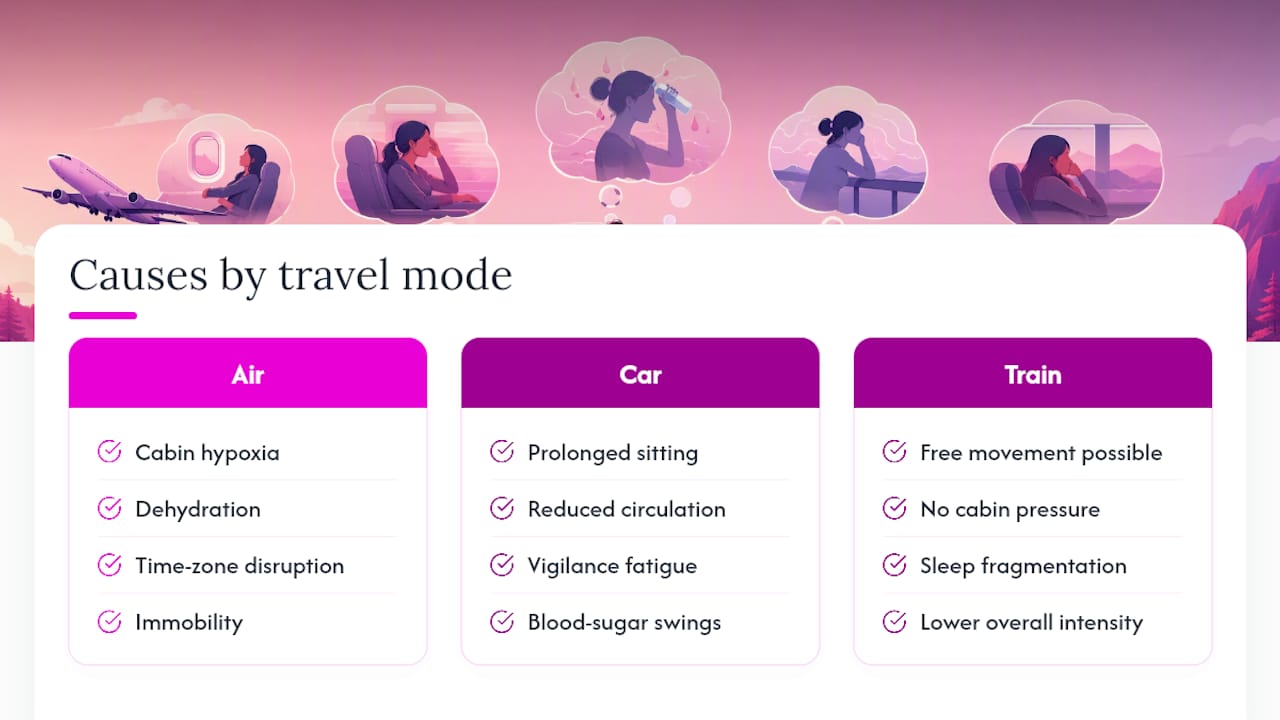
Car travel skips the altitude and cabin air issues but delivers its own version through prolonged sitting, reduced circulation, and the low-grade vigilance fatigue of hours behind the wheel. Long drives also tempt travelers toward fast food and energy drinks, stacking blood sugar swings on top of the physical fatigue.
Train travel tends to be the gentlest on cognition, since passengers can move around more freely and cabin pressure isn’t a factor, though overnight trains introduce their own sleep fragmentation from noise and motion. The common thread across all three: immobility and dehydration matter almost everywhere, but only flying adds the oxygen and time-zone layer that makes recovery take longer.
How Nuka Love’s Travel Strips Fit Into Your Brain Fog Toolkit
Hydration, movement, and light timing do most of the heavy lifting against travel fog, but having something compact and fast-acting for the gaps matters too, especially when you’re juggling a carry-on and a boarding call instead of measuring out powders. That’s the gap Nuka Love’s oral strip line is built to fill.

The CLARITY focus strips, built around lion’s mane, cordyceps, and other functional mushrooms, are designed as a mid-flight or pre-meeting option when you need a mental lift without reaching for another coffee that will wreck your sleep window later. For skin and energy support that travels well in a jacket pocket or seatback, the GLOW GETTER oral strips dissolve in seconds, no water, no pills to count out at 35,000 feet. And for the sleep side of the equation, the DEEP ZZZS oral sleep strips, coming soon, are built for the pre-bedtime window once you’ve landed and need your body to actually accept the new local night.
None of these replace hydration, movement, or talking to your provider about medication timing, but they’re built for exactly the moment when you don’t have a kitchen, a blender, or ten minutes to spare. Strips are available as a single purchase or through a recurring subscription if travel is a regular part of your life rather than an occasional trip. Check the CLARITY product page for current availability and start with whichever window, pre-flight, mid-flight, or bedtime, matches where your fog actually shows up.
What We’ve Learned About Landing Clearheaded
Our own travel routine at Nuka Love comes down to three moves repeated on every trip: drink water on a timer instead of waiting to feel thirsty, use a CLARITY strip around the midpoint of a long flight instead of a second coffee, and get outside into real sunlight within an hour of landing, no exceptions, even when the hotel bed is right there.
That third habit does more than people expect. Psychotherapist Alice McGuin has described travel as a kind of psychological pattern interrupt, disruptive at first, but ultimately capable of sharpening clarity once your system adjusts. We think the disruption is real and worth respecting, not muscling through. The travelers who recover fastest aren’t the ones who tough it out; they’re the ones who treat hydration, light, and rest as non-negotiable steps rather than afterthoughts squeezed in around a packed itinerary.
— NUKA
This article is general information, not a substitute for advice from a qualified doctor. Consult a qualified healthcare professional about your own circumstances before acting on anything here.
Sources
- Physiological stressors of flight and brain effects (PMC article)
- Jet lag overview and practical recovery strategies (Cleveland Clinic)
- CDC travel and mental health guidance
- How travel can reduce stress — mental health experts explain (Forbes, 2026)